

The role of client in renovation process is defined as active financial oversight, written decision-making authority, and direct coordination with contractors and building authorities to keep a project on schedule and within scope. This is not a passive position. Brooklyn homeowners, especially those in co-ops, carry specific legal and procedural responsibilities that directly determine whether a renovation finishes on time, on budget, and without costly disputes. At Designsbydandj, we see the same pattern repeatedly: projects run smoothly when clients are prepared and engaged, and they stall when clients are not.
What are the key client responsibilities during a renovation project?
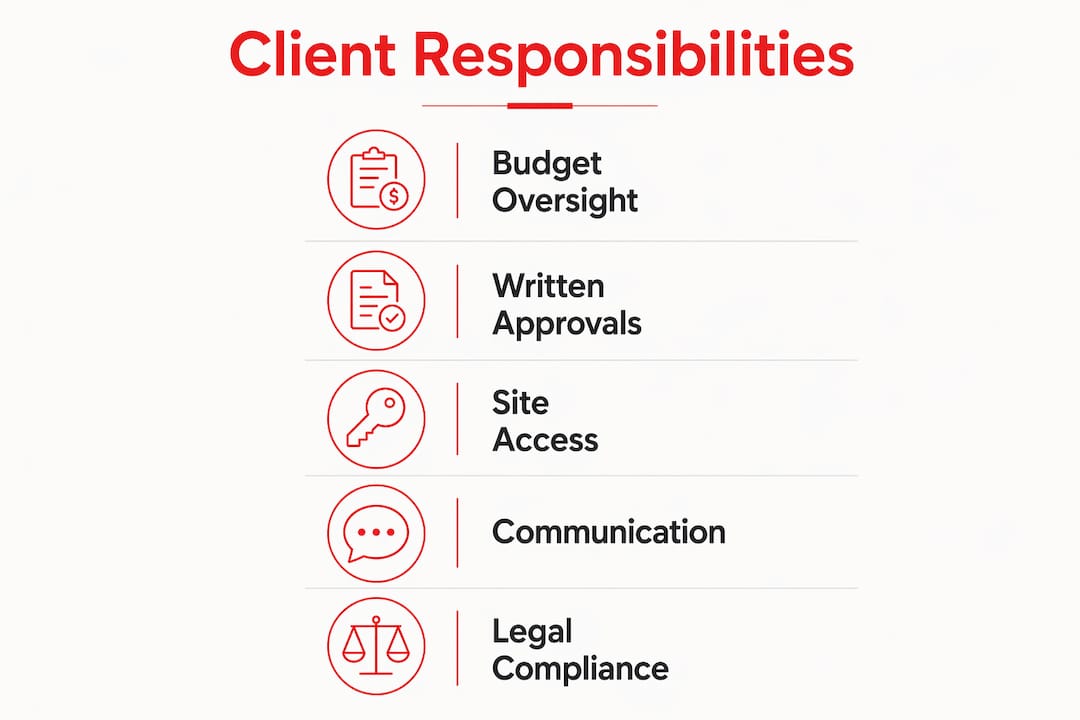
Client responsibilities in renovation fall into four core areas: budget oversight, decision approvals, site access, and communication. Each one affects the others, and neglecting any single area creates problems that compound quickly.
Budget oversight means more than approving an initial estimate. You track costs as work progresses, review invoices promptly, and flag discrepancies before they become disputes. Under New York’s Prompt Payment Statute, owners must approve invoices within 12 business days, with approved payments due within 30 days. Missing that window delays contractor cash flow and creates friction that slows your project.

Decision approvals require speed and documentation. Every time a contractor needs a selection confirmed, a material substituted, or a scope change authorized, a delay on your end translates directly into idle labor and pushed timelines. Your timely decisions are not a courtesy to the contractor. They are a contractual obligation.
Here are the core client responsibilities you should track from day one:
- Monitor the project budget weekly and compare actual costs against the approved estimate
- Approve or reject all change orders in writing before any additional work begins
- Provide site access on the schedule agreed in the contract
- Disclose known concealed conditions such as prior water damage, asbestos, or structural modifications before work starts
- Respond to contractor requests for decisions within 24 to 48 hours to prevent work stoppages
- Keep copies of all signed contracts, permits, and correspondence in one organized location
Pro Tip: Create a dedicated email folder or shared drive for your renovation from day one. Every approval, invoice, and change order goes there. If a dispute arises six months later, you will have a complete paper trail.
Providing accurate property information upfront is one of the most underrated client responsibilities. Undisclosed conditions discovered mid-project force redesigns, permit amendments, and unplanned costs that no one budgeted for.
How does the client effectively collaborate with contractors?
Effective client involvement in remodeling depends on structure, not just goodwill. The most productive client-contractor relationships run on scheduled communication, not reactive check-ins.
Weekly or bi-weekly meetings are the single most reliable way to stay aligned throughout a project. Each meeting should cover what was completed, what decisions are pending, and what is scheduled for the next period. This rhythm prevents the accumulation of unresolved questions that derail timelines.
Follow these steps to build a productive working relationship with your contractor:
- Set a meeting schedule before work begins. Agree on weekly or bi-weekly check-ins and put them in the contract or a written confirmation.
- Document every decision after each meeting. Send a brief written summary within 24 hours. Assigning decision ownership in writing eliminates the most common source of renovation confusion.
- Clarify roles upfront. Know who approves design changes, who communicates with the building super, and who handles permit inspections.
- Give input at the right time. Design decisions belong in the pre-construction phase. Changing your mind about tile placement after installation has started costs real money.
- Avoid micromanaging daily tasks. Trust the licensed tradespeople to execute. Your job is to make decisions and remove obstacles, not to supervise every cut and nail.
- Use a centralized communication platform. Tools like BRCKS consolidate project updates, approvals, and documentation in one place, reducing the chance that a critical message gets buried in a text thread.
Client communication quality directly influences renovation satisfaction and the likelihood of costly delays. Clients who stay engaged and responsive are simply easier to build for, and that translates into better outcomes.
What legal and building requirements do Brooklyn co-op clients face?
Brooklyn co-op renovations carry a layer of regulatory complexity that goes beyond standard city permits. The renovation project client role in a co-op includes compliance with building-specific rules that can override your own preferences and timeline.
NYC co-op clients must sign a building-specific Alteration Agreement before any contractor sets foot in the unit. Board approval lead times typically run 4 to 8 weeks, and work cannot begin until the agreement is fully executed and any required deposits are paid. This is not a formality. It is a binding contract that controls your entire project.
The Alteration Agreement functions as your renovation rulebook and typically covers:
- Permitted working hours, often restricted to weekdays between 9 a.m. and 5 p.m.
- Required insurance certificates for every contractor and subcontractor
- Scope restrictions, including which structural or mechanical systems can be modified
- Restoration clauses requiring you to return the unit to its original condition if work deviates from approved drawings
- Inspection requirements at specific project milestones
The building’s architect reviews plans on behalf of the co-op board, not on your behalf. Their approval protects the building’s interests. You still need your own architect or designer to represent your vision and verify that approved drawings match what you actually want built.
Review the NYC co-op renovation checklist before signing any agreement. Restoration clauses in particular carry serious financial risk. If your contractor deviates from approved drawings, even unintentionally, you may be required to undo completed work at your own expense.
Why are written change orders crucial for clients?
A change order is the formal written record of any modification to the original contract scope, cost, or timeline. Under N.Y. General Obligations Law § 15-301, contract modifications require written agreement with signatures from both the client and the contractor. Verbal approvals are not enforceable and are the leading cause of payment disputes in residential renovation.
| Scenario | Written Change Order | Verbal Approval |
|---|---|---|
| Scope clarity | Documented and agreed before work starts | Disputed after completion |
| Cost impact | Confirmed in writing with exact figures | Estimated verbally, often contested |
| Client leverage | Full contractual protection | Leverage disappears once work is done |
| Dispute risk | Minimal with signed documentation | High, especially for cost overruns |
Once additional work is completed without a signed change order, your ability to negotiate the cost drops to near zero. The contractor has already performed the work. You have no written record of what was agreed. Courts and arbitrators consistently side with the party that has documentation.
Every change order must include the specific scope of the additional work, the exact cost impact, the effect on the project timeline, and signatures from both parties before work begins. If a contractor pushes back on this process, that is a red flag worth taking seriously.
Pro Tip: Never approve a change order under time pressure. If a contractor says work must start immediately and paperwork can follow, ask them to pause until the document is signed. A one-day delay for proper documentation is always worth it.
How do timely decisions and communication affect project success?
Renovation delays are rarely caused by construction problems alone. Late decisions and undisclosed issues from the client side are among the most frequent causes of project overruns in residential remodeling. Your responsiveness is a direct input into the project schedule.
Here is what timely client communication looks like in practice:
- Approve material selections and finish choices before the scheduled installation date, not the morning of
- Review and approve invoices within the 12-business-day window required under New York’s Prompt Payment Statute
- Notify your contractor immediately if you discover a condition that may affect the work, such as a leak, mold, or a structural concern
- Confirm site access windows in advance so crews are not waiting outside a locked unit
- Use a shared project log or platform to track open items and pending decisions in real time
Clear, proactive communication reduces project chaos and client dissatisfaction throughout renovations. Clients judge a finished renovation not only by the final result but by how well they were kept informed during construction. That judgment cuts both ways: when you communicate clearly and respond quickly, your contractor can do the same.
The BRCKS change order guide for project managers reinforces that client authorization timing is one of the top factors in whether a change order becomes a dispute. Getting ahead of decisions, rather than reacting to them, keeps your project moving and your contractor relationship intact.
Key takeaways
The client’s role in a renovation is defined by written approvals, timely decisions, and compliance with building-specific rules. Passive involvement is the single most reliable predictor of cost overruns and disputes.
| Point | Details |
|---|---|
| Client role is active, not passive | Budget oversight, written approvals, and site access are contractual duties, not optional. |
| Change orders must be signed first | Never authorize additional work verbally. Get scope, cost, and signatures before work starts. |
| Co-op rules add a separate layer | Brooklyn co-op clients must execute an Alteration Agreement before any work begins. |
| Timely decisions protect your budget | Invoice approvals and material selections delayed by the client directly cause project overruns. |
| Documentation prevents disputes | Written meeting summaries and signed change orders are your primary protection if disagreements arise. |
What we’ve learned from years of Brooklyn renovations
The clients who have the smoothest renovations are not the ones who know the most about construction. They are the ones who show up prepared, ask questions early, and trust the process once it is in motion.
One pattern we see repeatedly at Designsbydandj: clients who delay signing the co-op Alteration Agreement because they want to “wait and see” end up losing their contractor’s scheduling window. Board approval alone takes 4 to 8 weeks. Add permit filing and material lead times, and a two-week delay at the start can push your move-in date by two months.
The other common pitfall is over-involvement in daily site decisions combined with under-involvement in the decisions that actually matter. Clients sometimes spend energy questioning which order tiles are being set while missing an invoice that needs approval or a change order that is sitting unsigned. Focus your attention on the decisions with financial and legal consequences. Let your skilled tradespeople handle the execution.
Preparation is the real differentiator. Clients who review their building’s alteration agreement before the first contractor meeting, who understand their budget contingency, and who know their own decision-making timeline give their project the best possible foundation. That preparation is something we walk every client through at Designsbydandj before a single tool is picked up.
— D&J
Ready to start your Brooklyn renovation with a clear plan?
At Designsbydandj, we guide Brooklyn homeowners through every phase of the renovation process with full transparency on scope, budget, and timeline. Our design-build approach means one team handles everything from initial design through final inspection, so nothing falls through the cracks.

Whether you are renovating a co-op in Park Slope or a brownstone in Bed-Stuy, we start by understanding how you want to live in the space. From there, we build a clear, step-by-step plan that keeps you informed and in control without the stress. Explore our design-build services or download our free homeowner checklist to prepare for your first consultation. Contact us today to get started.
FAQ
What is the client’s role in a renovation project?
The client’s role is to oversee the budget, approve decisions in writing, provide site access, and coordinate with contractors and building authorities throughout the project. Active client involvement prevents delays, cost overruns, and contractual disputes.
Do Brooklyn co-op owners need special approval before renovating?
Yes. NYC co-op clients must sign a building-specific Alteration Agreement before any work begins, and board approval typically takes 4 to 8 weeks. Work cannot start until the agreement is executed and required deposits are paid.
Why do change orders need to be in writing?
Under N.Y. General Obligations Law § 15-301, contract modifications require written signatures from both parties. Verbal approvals are unenforceable and are the leading cause of payment disputes in residential renovation.
How often should clients meet with their contractor during a renovation?
Weekly or bi-weekly meetings are recommended to review progress, confirm pending decisions, and prevent miscommunication. Documenting decisions after each meeting in writing reduces confusion and keeps the project on track.
What happens if a client delays approving invoices?
New York’s Prompt Payment Statute requires owners to approve invoices within 12 business days. Delays beyond that window disrupt contractor cash flow and can trigger disputes or work stoppages that push your project timeline back.



