
A design-build firm is defined as a single entity that holds one contract covering both the design and construction of your project. For Brooklyn homeowners weighing a kitchen gut renovation, a full-floor addition, or a basement conversion, this integrated model is the most direct path to a finished project that stays on budget and on schedule. The Design-Build Institute of America (DBIA) recognizes this delivery method as the fastest-growing in the construction industry, and the numbers back that up. Understanding why hire a design-build firm starts with one simple fact: you get one team, one contract, and one point of contact from the first sketch to the final inspection.
Why hire a design-build firm over traditional methods?
The traditional design-bid-build model splits your project into two separate contracts: one with an architect and one with a general contractor. That split creates a gap where miscommunication, budget overruns, and finger-pointing thrive. The design-build model closes that gap entirely.
Here is what the data shows about the concrete advantages of hiring design-build:
- Faster delivery. Design-build projects are completed on average 33.5% faster than traditional design-bid-build projects. On a Brooklyn brownstone renovation that might mean finishing before the school year starts instead of after the holidays.
- Real cost savings. Design-build delivery achieves 3.8% to 6.1% in cost savings compared to traditional methods through early integrated value engineering. On a $500,000 renovation, that is $19,000 to $30,500 back in your pocket.
- Fewer disputes. Design-build projects reduce conflicts by eliminating multiple contracts and aligning the entire team under a single goal. There is no architect blaming the contractor or vice versa when one firm owns both.
- Better budget transparency. Because designers and builders work together from day one, cost estimates are grounded in real construction pricing, not optimistic architectural assumptions.
- Lower administrative burden. You attend one meeting, review one contract, and make decisions with one team. That simplicity is significant when you are managing a renovation while living in or near the space.
The advantages of hiring design-build are not theoretical. They show up in your schedule, your budget, and your stress level.
How does the design-build process actually work?
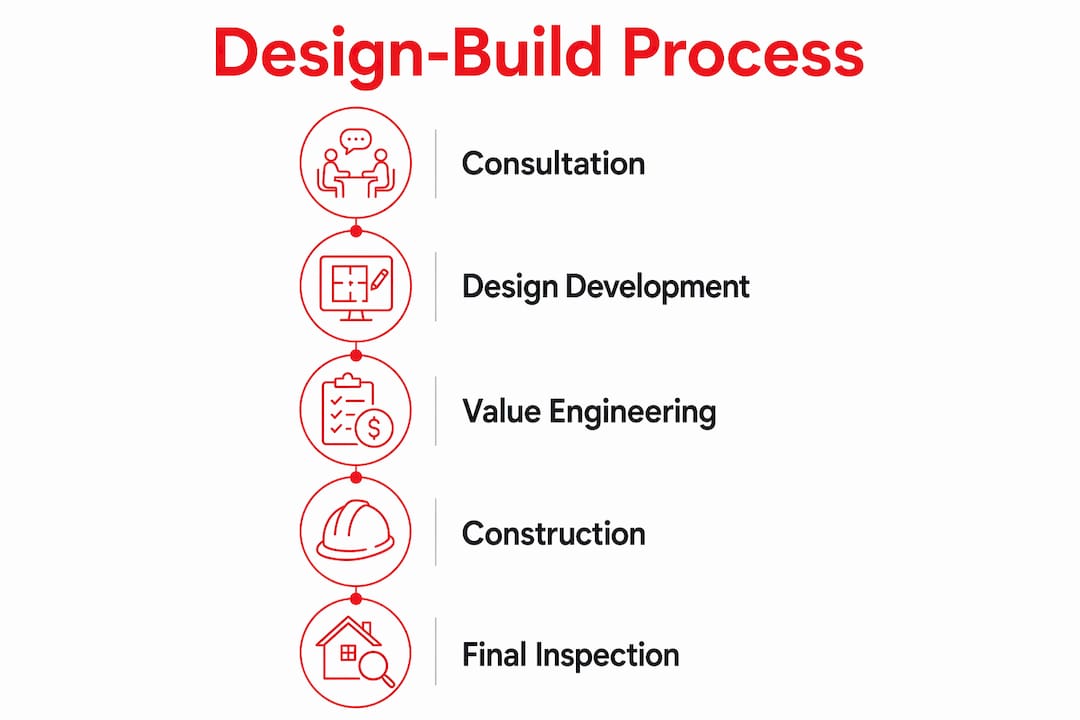
Many homeowners picture design ending before construction begins. That is the traditional model. In design-build, design and construction run concurrently with continuous design management during the build phase to maintain intent and avoid last-minute value engineering compromises. Here is how the process unfolds in practice:
- Discovery and programming. The firm meets with you to understand how you use the space, what your priorities are, and what budget range you are working within. This is not a sales call. It is the foundation of every decision that follows.
- Preconstruction and value engineering. In-house architects, engineers, and construction professionals build out the scope together. Early preconstruction engagement can recover 8 to 15% of hard construction costs through proactive value engineering, which means evaluating materials, mechanical configurations, and structural systems before final drawings are locked.
- Design development with real cost checks. As drawings progress, the construction team runs live cost checks against the design. If a material choice pushes the budget, the team adjusts in real time rather than discovering the problem after permits are filed.
- Construction with active design oversight. The same firm that designed your space builds it. That means the architect or designer is available throughout construction to resolve field conditions without delays or change orders caused by miscommunication.
- Closeout and handover. Final inspections, punch lists, and documentation are handled by one team that knows every detail of the project.
Pro Tip: Ask any design-build firm you interview whether their architects and project managers are in-house or contracted out. Firms with fully in-house teams have tighter coordination and faster decision-making, which directly protects your schedule.
The integrated design-build model allows real-time adjustments to design for budget and constructability, avoiding costly redesign during construction. That is a practical advantage you will feel every week the project is running.
Why does single-point accountability matter for homeowners?
Single-point accountability is one of the most underrated benefits of the design-build model, especially for Brooklyn homeowners managing tight timelines and limited tolerance for disruption.
“When one firm is responsible for both design and construction, there is nowhere for problems to hide. Issues get solved, not passed back and forth.” — DBIA on integrated project delivery
Single-point accountability reduces owner administrative burden and improves communication, avoiding the delays and disputes typical in traditional projects. Here is what that looks like in practice:
- You call one number when you have a question or concern.
- Change orders are evaluated by the same team that designed the change, so pricing is accurate and fast.
- If a field condition requires a design adjustment, the architect and builder solve it together the same day.
- Budget conversations happen with full context because the design and cost teams are the same people.
- Post-construction support comes from a firm that knows every detail of your project, not a contractor who handed off to someone else.
For a Brooklyn homeowner juggling work, family, and a renovation, this clarity is not a luxury. It is the difference between a project that feels manageable and one that consumes your life. Design-build delivery fosters a team-oriented culture with early collaboration among architects, engineers, and builders, which leads to on-time, on-budget delivery. That culture starts at the top and shows up in every interaction you have with the team.
What should you look for when choosing a design-build firm?
Not every firm that calls itself a design-build contractor operates with a fully integrated model. Vetting matters, and these are the criteria that separate reliable firms from those that simply rebrand a traditional approach.
In-house architecture and engineering
A true design-build firm employs architects and engineers on staff, not as outside consultants. When design and construction leadership share the same office, decisions happen faster and accountability is clearer. Ask to see the firm’s organizational chart before signing anything.

Self-performance of critical trades
Firms that self-perform critical trades have better control over schedules and quality than firms that subcontract all work. For a Brooklyn renovation, this matters most for trades that drive the schedule: framing, rough electrical, and plumbing. A firm that controls these directly can compress timelines and respond to field conditions without waiting on a subcontractor’s availability.
Contract structure transparency
Guaranteed Maximum Price contracts protect homeowners by providing cost certainty, while cost-plus contracts shift financial risk to the owner. Ask every firm you interview which contract type they use and why. A firm confident in its preconstruction process will offer a GMP. One that is not will push for cost-plus.
Local Brooklyn experience
Familiarity with local Brooklyn regulations and permit processes is a practical advantage that saves weeks. NYC Department of Buildings requirements, landmark district rules in neighborhoods like Park Slope or Brooklyn Heights, and co-op board approval processes all require local knowledge that a firm from outside the borough will lack.
Pro Tip: Request documentation of at least two completed preconstruction value engineering reports from local projects. A firm that cannot produce these has not been doing the work early enough to protect your budget.
Understanding common NYC renovation cost overruns before you sign a contract is one of the most practical things you can do as a homeowner. A qualified design-build firm will walk you through these risks during preconstruction, not after the fact.
Key takeaways
Hiring a design-build firm gives Brooklyn homeowners faster delivery, real cost savings, and a single accountable team from design through construction completion.
| Point | Details |
|---|---|
| Faster project delivery | Design-build projects finish 33.5% faster on average than traditional design-bid-build projects. |
| Built-in cost control | Early value engineering recovers 8 to 15% of hard construction costs before final drawings are locked. |
| Single-point accountability | One contract and one team eliminates disputes between architect and contractor throughout the project. |
| Vet for in-house capability | Firms with in-house architects and self-performing trades deliver tighter schedules and better quality control. |
| Contract type matters | A Guaranteed Maximum Price contract protects your budget; cost-plus contracts shift financial risk to you. |
What we have learned from Brooklyn renovations
After working on renovations across Brooklyn, from gut rehabs in Bed-Stuy to full-floor additions in Carroll Gardens, the pattern is consistent. Homeowners who come to us after a bad experience with the traditional model almost always describe the same thing: they felt like a referee between their architect and their contractor. Every problem became a negotiation about who was responsible, and every delay came with a bill.
The design-build model does not just fix that problem on paper. It fixes it because the incentives are aligned. When the same firm designs and builds your project, there is no financial benefit to blaming the other party. The firm either solves the problem or it does not. That accountability is what makes the relationship work.
What I would tell any Brooklyn homeowner is this: the firm matters as much as the model. A design-build firm that outsources its architecture, subcontracts every trade, and hands you a cost-plus contract is not delivering the real benefits of integrated delivery. Look for a firm that is genuinely integrated, transparent about its process, and willing to show you its work before you sign. The value engineering process should start in preconstruction, not after you have already committed to a scope and budget.
At Designsbydandj, we built our process around exactly this. We take the time to understand how you want to live in your space before we draw a single line. From there, every decision, every estimate, and every conversation is designed to keep you informed and in control.
— D&J
Start your Brooklyn renovation the right way
Designsbydandj is a family-owned design-build firm serving Brooklyn homeowners with a fully integrated process that covers design, permitting, and construction under one roof. We are known for clear estimates, honest timelines, and the kind of consistent communication that makes renovation feel manageable rather than overwhelming.
If you are ready to understand what a design-build approach looks like for your specific project, start with our hiring guide for New York. It walks you through exactly what to ask, what to look for, and how to protect your budget before you sign anything. You can also download our free homeowner checklist to prepare for your first consultation. We work with homeowners across Brooklyn and are ready to walk you through the next steps.
FAQ
What is a design-build firm?
A design-build firm is a single company that provides both architectural design and construction services under one contract. This integrated structure gives homeowners one point of contact and one accountable team for the entire project.
How does design-build save money compared to traditional methods?
Design-build delivery achieves 3.8% to 6.1% in cost savings through early value engineering, where architects and builders evaluate materials and systems together before final drawings are complete. On a $500,000 project, that represents up to $30,500 in savings.
Is design-build faster than hiring an architect and contractor separately?
Design-build projects are completed on average 33.5% faster than traditional design-bid-build projects because design and construction phases overlap rather than running sequentially.
What contract type should I ask for from a design-build firm?
Ask for a Guaranteed Maximum Price contract, which caps your total cost and places the financial risk on the firm rather than on you. Cost-plus contracts shift that risk back to the homeowner.
How do I know if a design-build firm is truly integrated?
Ask whether architects and engineers are on staff or contracted out, and whether the firm self-performs any critical trades. A genuinely integrated firm will have in-house design professionals and direct control over at least some of the key construction work on your project.