

Effective communication in home renovation is the single most reliable predictor of whether a project finishes on time, on budget, and to your satisfaction. In the construction industry, this concept falls under the broader practice of project communication management, which covers how information flows between homeowners, contractors, designers, and tradespeople from day one through final walkthrough. When that flow breaks down, the consequences are concrete and costly. When it works, renovation feels exciting rather than frustrating. This article gives you the frameworks, habits, and real-world examples to make clear communication your strongest project tool.
Why communication matters in renovation timelines and budgets
Poor communication is the leading cause of avoidable cost overruns and schedule delays in home renovation. Decision delays and unclear instructions can cause home extensions to overrun by 3–6 weeks, with budgets increasing by thousands of dollars due to rework that should never have been necessary. That is not a minor inconvenience. It is a structural failure in how the project was managed from the start.
The most damaging scenario is idle trades. When a homeowner has not confirmed a tile selection or approved a layout change, electricians and plumbers pause work or leave the site entirely. Getting them back costs money in return-visit fees and pushes every subsequent trade further down the calendar. Rewiring a single room costs between $500 and $1,500, and replastering adds $300–$800 per room. When multiple trades are involved, those numbers compound fast.
The most common communication failures that cause these problems include:
- Delayed material selections. Choosing tile, fixtures, or cabinetry late forces trades to pause or reschedule.
- Verbal-only agreements. Instructions given in conversation but never written down get misremembered or disputed.
- Unclear scope definitions. Vague project descriptions lead to assumptions that produce the wrong result.
- Slow decision responses. A contractor waiting two days for a yes or no can lose a week of scheduling momentum.
- Unmanaged email chains. Long threads with multiple parties create confusion about which instruction is current.
Every one of these failures is preventable. The fix is not more meetings. It is better, more deliberate communication from the first planning conversation onward.
How to build an effective communication plan with your renovation team
The foundation of good project communication is alignment before work begins. Clear communication is a core project management function that reduces costly site-level changes by aligning the team with homeowner intent early. That alignment starts with a structured pre-construction conversation covering your lifestyle needs, budget limits, design priorities, and non-negotiables.
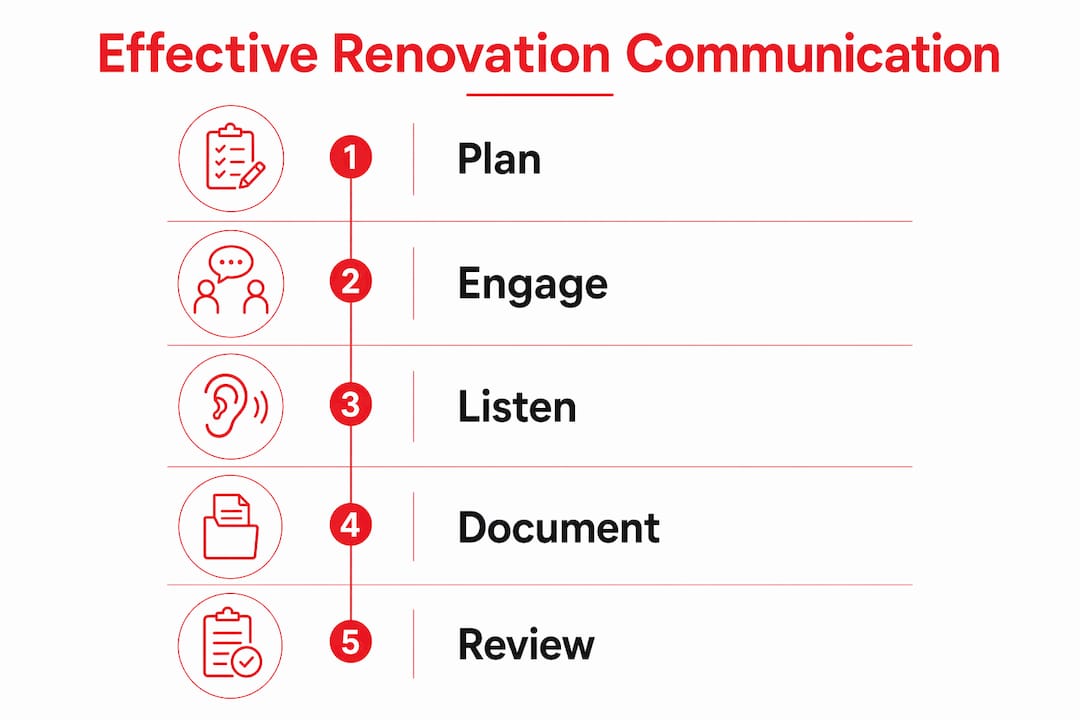
A practical communication plan for homeowners includes these steps:
- Define your priorities in writing before the first contractor meeting. List what matters most: timeline, budget, specific finishes, or minimal disruption to daily life.
- Assign a single point of contact on your side. If two homeowners are involved, decide who makes final calls to avoid conflicting instructions reaching the contractor.
- Agree on communication channels upfront. Direct, recorded conversations outperform unmanaged email chains for resolving issues. Phone calls or video calls with a written follow-up summary work best.
- Schedule weekly check-ins. Weekly structured updates, including site meetings and walk-throughs, maintain alignment and prevent overload. A typical meeting runs 20–40 minutes covering completed work, upcoming tasks, and open decisions.
- Create a decision log. Track every choice made, who approved it, and when. This document protects you and your contractor equally.
- Set deadlines for your own decisions. If the contractor needs a tile selection by Friday to keep the plumber on schedule, put that deadline in your calendar.
Pro Tip: Send a brief written summary after every phone call or site visit. A two-sentence recap of what was agreed prevents “I thought you said” disputes before they start.
This structure does not require expensive software. A shared document or a simple spreadsheet covers most of what a homeowner needs. The goal is consistency, not complexity. For more guidance on contractor communication tips, Designsbydandj has published a practical resource specifically for NYC homeowners.
How active listening improves your renovation outcomes
Most homeowners plan their response during a conversation rather than fully listening to what is being said. People typically absorb only 17–25% of what others share. That means three-quarters of what your contractor tells you in a site meeting may not register. Awareness of this gap is the first step to closing it.

Active listening in a renovation context means giving your full attention during site visits, asking clarifying questions before responding, and resisting the urge to multitask during calls. It also means watching for nonverbal cues. A contractor who hesitates before agreeing to a timeline may be signaling doubt. A pause before answering a budget question often means the number is tighter than comfortable. These signals carry real information.
Homeowners who listen well also raise concerns earlier. Early concerns are cheap to address. Late concerns are expensive. If something looks wrong during a framing inspection, saying so immediately costs nothing. Waiting until drywall is up can cost thousands in rework. Your role as a client includes speaking up clearly and early, not just approving invoices.
Practical habits that sharpen your listening during renovations:
- Put your phone away during site meetings. Distraction is the enemy of retention.
- Repeat back key decisions in your own words to confirm understanding.
- Ask “what do I need to decide before your next visit?” at the end of every meeting.
- Use digital tools and video calls for real-time updates when you cannot be on site, but treat them as a supplement to in-person visits, not a replacement.
Pro Tip: After each site visit, write down the three most important things you heard. If you cannot recall three, you were not fully present.
Collaborative problem-solving also matters here. When something goes wrong, the instinct to assign blame slows everything down. A homeowner who says “how do we fix this together?” gets faster, better solutions than one who leads with accusations.
Managing change orders and surprises through transparent dialogue
Change orders are the most common source of renovation conflict. Significant late changes disrupt schedules and increase costs, so amendments must be discussed openly, priced transparently, and agreed upon in writing before any work proceeds. This is not a contractor protection tactic. It protects you equally.
The table below shows how transparent communication changes the outcome of common renovation surprises:
| Situation | Without clear communication | With clear communication |
|---|---|---|
| Homeowner wants to relocate a wall | Work proceeds on assumption, wrong wall moved | Change discussed, repriced, and approved before execution |
| Material arrives damaged or delayed | Contractor substitutes without notifying homeowner | Homeowner informed immediately, alternative selected together |
| Electrical upgrade required by inspector | Homeowner surprised by added invoice | Scope and cost explained before work begins |
| Homeowner changes tile selection mid-project | Installer proceeds with original tile, conflict follows | New selection confirmed in writing, schedule adjusted |
Documenting scope, agreements, and changes in writing protects your vision and your investment. Every change order should include a description of the change, the revised cost, and the impact on the project timeline. A contractor who resists putting changes in writing is a contractor worth questioning.
Transparency also builds trust that keeps projects moving. When a homeowner understands why a change costs more or takes longer, they are far more likely to approve it quickly and maintain a productive working relationship with the team. Delays caused by distrust are just as expensive as delays caused by poor planning.
Key Takeaways
Clear communication is the most cost-effective tool a homeowner has during any renovation, directly preventing delays, rework, and budget overruns.
| Point | Details |
|---|---|
| Poor communication costs real money | Decision delays can extend projects by 3–6 weeks and add thousands in avoidable rework costs. |
| Written documentation protects everyone | Every agreement, change, and decision should be confirmed in writing to prevent disputes. |
| Active listening is a skill to practice | Homeowners absorb only 17–25% of what is shared; deliberate listening closes that gap significantly. |
| Weekly check-ins maintain alignment | A 20–40 minute weekly meeting covering tasks and open decisions keeps all parties on the same page. |
| Change orders need written approval | All scope changes must be priced and agreed upon before work begins to avoid surprise invoices. |
What I’ve learned about communication after years of renovations
The homeowners who have the smoothest renovations are not always the ones with the biggest budgets. They are the ones who show up prepared, ask clear questions, and treat communication as part of their job on the project.
The most common mistake I see is homeowners who go quiet. They receive a weekly update, skim it, and assume everything is fine. Then a decision deadline passes, a trade leaves the site, and suddenly the project is two weeks behind with no obvious cause. The cause is silence. Silence is not neutral in a renovation. It reads as approval, and it costs money.
The second mistake is treating every problem as a crisis. Renovations surface surprises. That is not a sign of a bad contractor. It is the nature of working inside existing structures. What separates a good project from a stressful one is how quickly and honestly those surprises get communicated. A contractor who calls you the moment an issue appears is doing their job well. A contractor who waits until Friday to mention a Monday problem is not.
The homeowners I have seen finish projects feeling genuinely satisfied share one trait. They stayed engaged without micromanaging. They asked good questions, made decisions on time, and trusted the process their team laid out. Communication was not something that happened to them. It was something they actively participated in.
— D&J
How Designsbydandj keeps your renovation on track
Designsbydandj is a family-owned design-build firm built around one principle: you should always know what is happening with your project and why.

From the first consultation, Designsbydandj takes time to understand how you want to live in your space, what your priorities are, and what the finished result should feel like. That clarity drives every conversation that follows. The team provides transparent scope, honest timelines, and consistent updates throughout construction, so nothing comes as a surprise. If you are planning a renovation in NYC or Brooklyn, the design-build remodeling services at Designsbydandj are built around the kind of communication that keeps projects moving and clients confident. You can also learn more about the full design-build approach and how it compares to traditional contracting.
FAQ
Why does communication matter so much in renovation?
Poor communication causes the majority of renovation delays and cost overruns. Decision delays alone can extend a project by 3–6 weeks and add significant unplanned costs through rework and idle trades.
What is the best way to communicate with a renovation contractor?
Direct, recorded conversations followed by a written summary outperform unmanaged email chains. Weekly check-ins of 20–40 minutes covering completed work, upcoming tasks, and open decisions keep projects aligned.
How does active listening affect renovation outcomes?
People absorb only 17–25% of what others share, so deliberate listening during site meetings significantly reduces misunderstandings. Repeating back key decisions and asking clarifying questions before responding improves retention and accuracy.
Do all change orders need to be in writing?
Every change order must be documented in writing with a revised cost and timeline impact before work begins. Written documentation protects both the homeowner and the contractor from disputes.
How can I avoid renovation delays caused by slow decisions?
Set personal deadlines for material selections and approvals tied to the contractor’s schedule. When a contractor needs a decision by a specific date to keep trades on site, treat that date as a hard deadline.



