

Return on renovation investment (ROI) is the percentage of your renovation cost you recover through increased home value or sale price. Industry professionals call this metric “renovation ROI” or “cost vs. value ratio,” and it is the single most useful number for deciding whether a project is worth your money. For New York homeowners, where property values are high and buyer expectations are specific, understanding renovation ROI before you spend a dollar is not optional. It is the difference between a smart investment and an expensive mistake.
What is return on renovation investment and how is it calculated?
Renovation ROI measures how much financial value a project adds relative to what it costs. The standard formula is: (Resale Value Added minus Project Cost) divided by Project Cost, multiplied by 100. A result of 100% means the project pays for itself completely. A result of 75% means you recover 75 cents for every dollar spent.
Here is a simple example. You spend $20,000 on a minor kitchen remodel. At sale, your home’s value increases by $19,200. Your ROI is 96%. That is a strong return. Now compare that to a $75,000 full kitchen gut renovation that adds $42,000 in value. Your ROI drops to 56%. The bigger spend does not always produce the bigger return.

Most standard interior renovations recover between 50% and 100% of their cost, depending on project type and local market conditions. That range tells you something important: very few renovations pay back more than you put in, so choosing the right project matters enormously.
There is also a meaningful difference between financial ROI and use-value ROI. A pool, for example, may deliver low financial ROI but years of personal enjoyment. Both types of return are real. The key is knowing which one you are chasing before the project starts.
Pro Tip: Deferred maintenance often delivers the highest ROI of all. Fixing a leaking roof or outdated electrical panel prevents costly future repairs and protects your home’s sale value at inspection.
- Write down your total project cost, including labor, materials, permits, and design fees.
- Research comparable home sales in your neighborhood to estimate value added.
- Apply the formula: (Value Added minus Project Cost) divided by Project Cost, multiplied by 100.
- Compare your result against national benchmarks from sources like the Remodeling Magazine Cost vs. Value Report.
- Weigh financial ROI against personal use-value before making a final decision.
Which home renovations yield the highest ROI in 2026?
The 2026 data on renovation projects ROI is clear, and the results surprise most homeowners. Exterior projects dominate the top of the list. Garage door replacement delivers approximately 194% ROI and manufactured stone veneer reaches 153% ROI. These numbers mean you recover nearly double your cost on a garage door and one and a half times your cost on stone veneer.
Why do exterior projects perform so well? Low-cost exterior upgrades rank highest in ROI because they are highly visible and cost-efficient. A garage door replacement typically costs $4,000–$5,000. It is the first thing a buyer sees. That visibility creates an outsized impression relative to the actual spend.
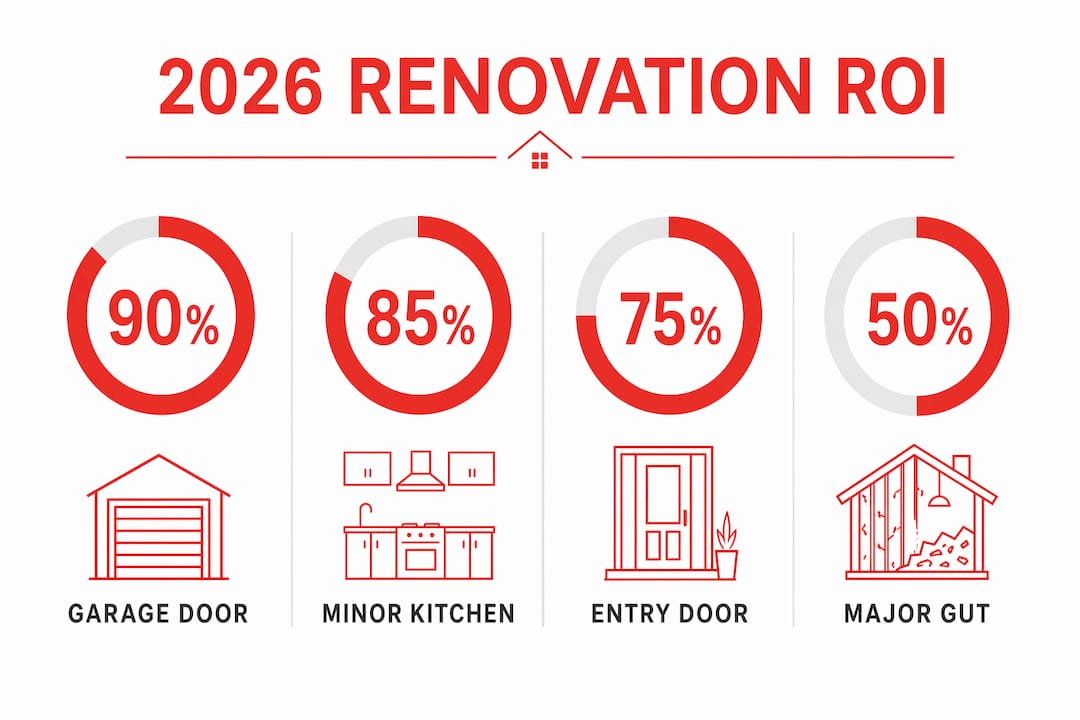
The table below compares the top renovation projects by ROI, average cost, and value added nationally in 2026.
| Renovation Project | Average Cost | Value Added | Approximate ROI |
|---|---|---|---|
| Garage Door Replacement | $4,500 | $8,750 | 194% |
| Manufactured Stone Veneer | $11,000 | $16,800 | 153% |
| Minor Kitchen Remodel | $27,000 | $26,000 | 96% |
| Major Kitchen Remodel | $75,000 | $42,000 | 56% |
| Bathroom Addition | $55,000 | $30,000 | 54% |
Minor kitchen remodels recover 85–96% of cost whereas major gut renovations return only 50–60%. That gap is significant. A minor remodel means new cabinet fronts, updated hardware, a fresh backsplash, and modern fixtures. You are not moving walls or replacing plumbing. The result looks dramatically different to a buyer, but costs a fraction of a full gut job. For NYC kitchen renovation costs and what drives them, the NYC kitchen cost breakdown from Designsbydandj is worth reviewing before you budget.
Pro Tip: Resist the urge to over-invest in high-end finishes for a mid-range neighborhood. Buyers in that price tier will not pay a premium for imported marble countertops. Match your finish level to your neighborhood’s price ceiling.
How do regional factors and timing influence renovation ROI in new york?
New York City’s real estate market operates by its own rules. National ROI averages from the Cost vs. Value Report are useful benchmarks, but they do not fully capture what happens in Brooklyn, Queens, or Manhattan. Renovation ROI is highly subjective and varies by region, and NYC’s market dynamics differ greatly from other areas in how value is captured.
Several factors make New York unique:
- Neighborhood price ceilings are real. Spending above the maximum typical home value in your neighborhood limits your ROI regardless of renovation quality. A $150,000 kitchen in a block where homes sell for $600,000 will not push your sale price to $750,000.
- Over-capitalization is a common mistake. This happens when your total renovation investment pushes your home’s cost basis above what the local market will support. It is especially common in outer borough neighborhoods with tighter price bands.
- Buyer preferences differ from national norms. Finished basements, for example, are a top ROI project in many suburban markets but are far less relevant in most NYC apartments and townhomes. Know what your specific buyers want.
- Absolute dollar returns are higher in NYC. ROI percentages stay similar across regions, but absolute value varies. A 96% ROI on a kitchen remodel in Manhattan adds more dollars than the same project in a lower-priced market.
- Timing your sale matters more than most homeowners realize. A renovation completed just before listing retains full credit with buyers. One done three years earlier loses impact as the “newness” fades and competing listings catch up.
The practical takeaway for New York homeowners: always research your specific neighborhood’s comparable sales before committing to a major renovation budget. National data points you in the right direction. Local data tells you exactly where to land.
How to maximize return on renovation investment in your new york home
Maximizing your home improvement return is about making deliberate choices, not just spending more. The following practices consistently produce better outcomes for NYC homeowners.
Cap your spending per project at 5% of your home’s value. For a $400,000 home, that means keeping any single renovation under $20,000 to avoid over-improvement. For a $1.2 million Brooklyn brownstone, your ceiling is $60,000 per project. This rule protects you from the most common ROI mistake.
Prioritize curb appeal and cosmetic upgrades over major structural work. Exterior paint, updated entry doors, landscaping, and lighting are all high-visibility, low-cost projects. They shape a buyer’s first impression before they step inside. Interior cosmetic work like fresh paint, refinished floors, and updated fixtures also delivers strong returns at a fraction of gut-renovation costs.
Time your renovations close to your listing date. If you plan to sell within 12 months, complete renovations in the 3–6 months before you list. This keeps everything looking fresh and current for buyers.
Work with a trusted, licensed contractor who knows the NYC market. Quality of execution directly affects perceived value. A poorly installed tile job or a paint finish that shows brush marks will undercut even the best project selection. Use the NYC renovation calculator from Designsbydandj to model costs and returns before committing to a scope.
Balance financial ROI with personal use-value. If you plan to stay in your home for 10 years, a renovated bathroom or updated kitchen delivers daily quality-of-life returns that do not show up in a resale calculation. Factor that in honestly. The benefits of home renovations extend well beyond what a buyer will pay at closing.
Pro Tip: Before starting any renovation, pull recent sold listings within a half-mile radius of your home. Look at what the top-selling homes have in common. That list tells you exactly where to spend your renovation budget.
Key takeaways
Renovation ROI is the most reliable financial tool for deciding which home improvements are worth your money, and in New York, local market knowledge is what separates a good decision from a costly one.
| Point | Details |
|---|---|
| ROI formula is straightforward | Subtract project cost from value added, divide by cost, multiply by 100 for your percentage. |
| Exterior projects lead in 2026 | Garage door replacement (194%) and stone veneer (153%) outperform most interior remodels. |
| Minor beats major in kitchens | Minor kitchen remodels recover 85–96% of cost; major gut renovations return only 50–60%. |
| NYC has neighborhood price ceilings | Over-improving above your block’s price ceiling limits returns regardless of renovation quality. |
| Timing and execution both matter | Renovate close to your listing date and use a skilled contractor to protect perceived value. |
What we’ve learned working with new york homeowners on ROI
Most homeowners we talk to at Designsbydandj come in with the same assumption: bigger renovation equals bigger return. That assumption is wrong more often than it is right. We have seen $80,000 kitchen renovations that added $40,000 in value and $12,000 exterior refreshes that moved sale prices by $25,000. The pattern is consistent enough that we now treat it as a rule.
The other misconception we see regularly is treating renovation ROI as a purely financial calculation. It is not. A homeowner who renovates a bathroom and then enjoys it for eight years before selling has received real value that no spreadsheet captures. We always ask clients two questions before scoping a project: “Are you renovating to sell, or renovating to live?” The answer changes everything about how we approach the budget and the scope.
What we have found works best in New York is a disciplined combination of local market research, honest budgeting, and quality execution. You can have the right project and the right budget and still lose ROI to poor workmanship. That is why the contractor relationship matters as much as the project selection. Transparency around scope, timeline, and cost is not just good service. It is how you protect your investment from the start.
— D&J
How Designsbydandj helps you get the most from every renovation dollar
Knowing your renovation ROI is one thing. Executing a project that actually delivers it is another. Designsbydandj is a family-owned design-build firm serving New York homeowners with a clear, step-by-step process that keeps your budget, timeline, and quality goals aligned from day one.

If you are planning a renovation and want to make sure your investment is positioned for the best possible return, start with the right contractor relationship. Read our guide on hiring a design-build contractor in New York to understand what to look for and what questions to ask. You can also download our free homeowner checklist to plan your renovation with confidence. When you are ready to talk through your specific project, our team is here to help you make a decision grounded in real numbers.
FAQ
What is a good ROI percentage for a home renovation?
A renovation ROI above 70% is generally considered strong for interior projects. Exterior projects like garage door replacement can exceed 100%, meaning they add more value than they cost.
Does renovation ROI differ in new york compared to national averages?
The ROI percentage stays similar to national figures, but the absolute dollar value is higher in New York due to elevated property prices. Local neighborhood price ceilings still apply and can limit returns on over-improvements.
How soon before selling should i renovate?
Completing renovations 3–6 months before listing produces the best results. Renovations done years earlier lose their “newness” factor and deliver less resale impact at the time of sale.
Is a minor or major kitchen remodel a better investment?
A minor kitchen remodel is the better financial investment, recovering 85–96% of cost compared to 50–60% for a major gut renovation. The visual impact of a minor remodel is high relative to its cost.
Does renovation ROI include personal enjoyment value?
Standard renovation ROI calculations measure only resale value added versus cost. Personal use-value, such as years of enjoying an updated bathroom or kitchen, is real but separate from the financial return metric.