

An owner-occupant renovation is defined as renovation work performed on a property that the owner intends to occupy as their primary residence, not merely to rent out or resell. The industry term is “owner-occupied renovation,” and it carries real weight with lenders, the U.S. Department of Housing and Urban Development (HUD), and federal loan programs. Your occupancy intent shapes which loans you qualify for, what rates you pay, and what legal obligations you take on. For Brooklyn homeowners, understanding this distinction before breaking ground is not optional. It directly affects your financing, your timeline, and your legal standing.
What does owner-occupant renovation mean for your loan eligibility?
Owner-occupant status is defined by one core requirement: you must intend to live in the property as your primary residence. This is not just a preference you state verbally. Lenders require written intent statements, and your occupancy status determines whether you qualify for owner-occupied loan programs at all. An owner-occupant differs from an absentee owner, who holds title but does not live on the property. That single distinction changes your loan eligibility, your interest rate, and your renovation financing options entirely.
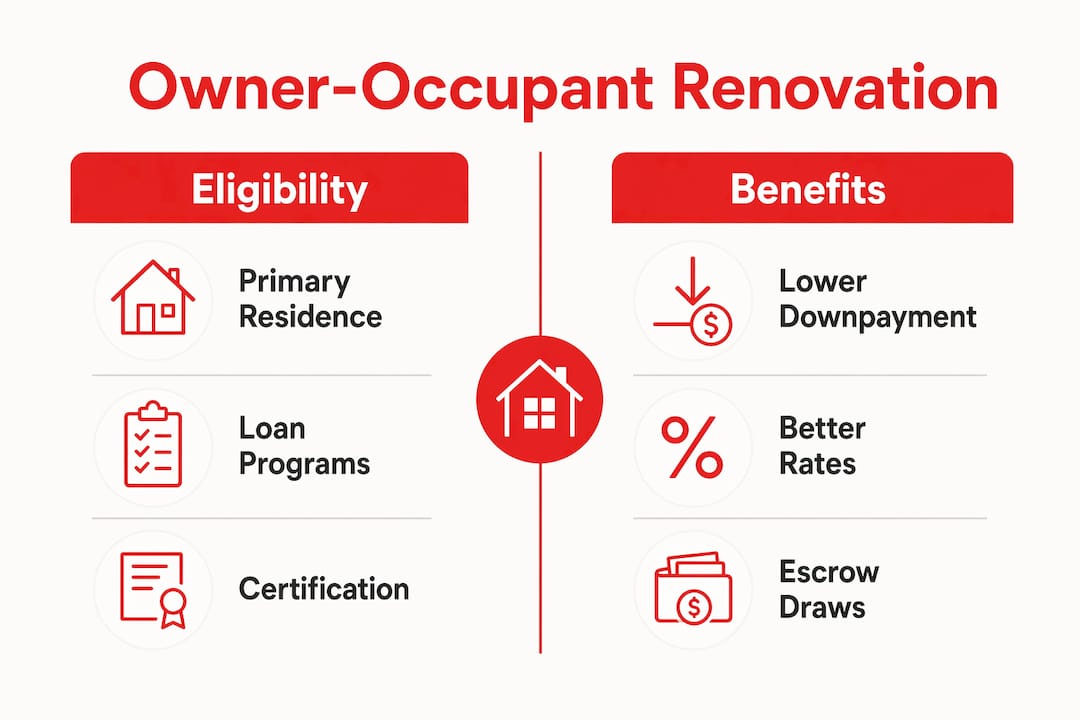
The practical implication is significant. Loan programs reserved for owner-occupants offer lower down payments, better interest rates, and access to renovation-specific products that investors cannot use. If you plan to renovate a brownstone in Crown Heights and move in afterward, you qualify as an owner-occupant. If you plan to flip it, you do not. Lenders verify this intent through your loan application, signed affidavits, and post-closing follow-up.

What are the occupancy requirements for owner-occupant renovations?
Occupancy requirements are specific and non-negotiable under most loan programs. Meeting them protects your loan classification and keeps your financing terms intact.
The standard requirements across major programs include:
- Move-in window: You must occupy the property within 60 days of closing on most mortgage programs, including FHA and conventional loans.
- Minimum occupancy duration: You must maintain the property as your primary residence for at least one year after move-in.
- Proof of occupancy: Lenders may request utility bills, a driver’s license showing the address, or a signed occupancy affidavit.
- Loan reclassification risk: Failing to meet move-in requirements can reclassify your loan as an investment property loan, which carries higher rates and stricter terms.
- Program-specific variations: FHA 203(k) and Fannie Mae’s CHOICERenovation program each have their own occupancy timing rules tied to renovation completion milestones.
The FHA 203(k) program requires you to occupy the home as your primary residence. Fannie Mae’s CHOICERenovation program takes a slightly different approach. It treats the property as owner-occupied from closing even if you are not physically living there during construction, as long as you move in within 60 days after the final renovation draw is disbursed. This flexibility matters for Brooklyn homeowners doing full gut renovations where the home is not livable during construction.
Fannie Mae also requires at least one borrower to confirm primary residence intent through the loan application and signed affidavits. Occupancy intent is verified at underwriting, not just at closing.
Pro Tip: Keep a folder with your lease agreement for temporary housing, your utility setup confirmation at the renovation address, and any lender correspondence about your move-in date. This documentation protects you if your occupancy timeline is ever questioned.
How does owner-occupant status affect renovation financing options?
Owner-occupant status unlocks renovation loan products that are simply not available to investors. The two most widely used are the FHA 203(k) loan and the Fannie Mae CHOICERenovation mortgage.
| Feature | FHA 203(k) | CHOICERenovation |
|---|---|---|
| Occupancy requirement | Primary residence only | Primary residence from closing |
| Renovation fund handling | Held in escrow, released in draws | Held in escrow, released in draws |
| Move-in timing | Within 60 days of closing | Within 60 days after last draw |
| Down payment | As low as 3.5% | Varies by conventional terms |
| Eligible property types | 1–4 unit residential | 1–4 unit residential |
With the FHA 203(k) program, renovation funds are held in escrow and released to contractors in draws as approved work is completed. This draw schedule directly affects your renovation timeline. Your contractor gets paid in stages, not upfront, so your project schedule must align with draw release milestones. Delays in inspections or approvals can slow payments and stall construction.
Conventional renovation underwriting separates “not living in the property during construction” from “owner-occupied status for loan terms.” This is a critical nuance. You can be classified as an owner-occupant for loan pricing purposes even while the home is under construction, provided you meet the post-renovation move-in deadline. Missing that window changes your loan class and your terms.
Owner-occupied loans also carry lower interest rates than investment property loans. The rate difference can be meaningful over a 30-year mortgage. For a Brooklyn homeowner financing a full kitchen and bathroom renovation through a CHOICERenovation mortgage, the savings in interest over the loan term can be substantial.
Pro Tip: Talk to your lender before scheduling your renovation start date. The draw release schedule under your specific loan program should drive your contractor’s payment milestones, not the other way around.
What legal and certification obligations come with owner-occupant renovations?
Owner-occupant status is not just a financial classification. It is a legal declaration with real consequences for false statements.
When you apply for an owner-occupied renovation loan, you sign an Owner-Occupant Certification. HUD uses form HUD-9548D for certain programs, and similar affidavits are standard across FHA and conventional loan applications. By signing, you are legally affirming that you intend to occupy the property as your primary residence.
Submitting a false owner-occupant certification can carry penalties of up to $250,000 in fines or up to two years in prison under federal law.
The legal obligations extend beyond the initial certification:
- Ongoing occupancy: You must actually live in the home for the required period, not just sign a form saying you will.
- Lender notification: If your circumstances change and you cannot meet the occupancy requirement, notify your lender immediately. Proactive communication is far better than a compliance audit.
- Underwriting verification: Lenders verify occupancy intent through your loan application, employment records showing your work location, and sometimes post-closing follow-up calls or letters.
- Renovation project documentation: Your renovation scope, permits, and contractor agreements must align with the property being your primary residence, not a rental or flip.
For Brooklyn homeowners working with renovation red flags already on their radar, adding a legal compliance layer to the project can feel like a lot. The key is treating your occupancy certification as seriously as your building permits. Both carry legal weight, and both require honest, accurate documentation.
How do owner-occupant renovations affect project planning and daily living?
Managing a renovation while meeting occupancy commitments requires planning that most homeowners underestimate. The construction timeline, your living arrangements, and your lender’s draw schedule all need to work together.
Follow these steps to keep your project on track:
- Confirm your move-in deadline with your lender before construction starts. Know whether your 60-day clock starts at closing or after the final draw. This single date should anchor your entire project schedule.
- Arrange temporary housing with a written lease agreement. If you are renting elsewhere during construction, document your temporary rental with a signed lease and notify your lender. This protects your owner-occupant status.
- Build a realistic construction timeline with your contractor. Account for permit approval times in Brooklyn, which can run several weeks depending on the scope of work. Factor in draw inspection delays as well.
- Schedule phased renovations if possible. If your loan program allows it, completing the most critical systems first (structural, HVAC, plumbing) lets you occupy part of the home sooner. Understanding HVAC in home renovation is especially relevant here, since heating and cooling systems affect when a space is livable.
- Maintain consistent communication with your lender and contractor. Any change in scope, timeline, or living arrangements should be documented and shared with both parties promptly.
Renovation draw mechanics dictate when contractors get paid and when your home becomes livable. Your moving plans must account for these milestones, not just the construction calendar. A contractor who finishes framing ahead of schedule cannot be paid until the draw inspection clears. That gap affects your move-in date.
Pro Tip: Ask your lender for a written draw schedule before construction begins. Share it with your contractor so both parties understand payment timing and can plan accordingly.
Key Takeaways
Owner-occupant renovation status is a legal and financial classification that shapes every aspect of your project, from loan eligibility to move-in timing to contractor payment schedules.
| Point | Details |
|---|---|
| Core definition | An owner-occupant renovation is work done on a home you intend to occupy as your primary residence. |
| Occupancy timeline | Most programs require you to move in within 60 days and stay for at least one year. |
| Financing advantage | Owner-occupant status unlocks FHA 203(k) and CHOICERenovation loans not available to investors. |
| Legal risk | A false occupancy certification can result in fines up to $250,000 or up to two years in prison. |
| Planning priority | Align your construction schedule with your lender’s draw release milestones before work begins. |
What Brooklyn homeowners get wrong about owner-occupant renovations
Most homeowners I work with in Brooklyn understand that they need to live in the home. What they miss is how tightly their renovation schedule, their loan draw timeline, and their legal occupancy obligations are connected. These are not three separate things. They are one system, and a delay in any part affects the others.
The most common mistake I see is treating the move-in deadline as flexible. It is not. If your loan program requires you to occupy the home within 60 days after the final draw, and your renovation runs long, you may miss that window. That can reclassify your loan, change your rate, and trigger a compliance review. I have seen homeowners lose favorable financing terms because a permit delay pushed their move-in past the deadline.
The second mistake is skipping documentation. If you are renting a temporary apartment in Park Slope while your Bed-Stuy brownstone is under renovation, you need a written lease and you need to tell your lender. Silence is not neutral. It looks like concealment during an audit.
Brooklyn’s housing stock adds another layer. Two-family homes, co-ops, and pre-war buildings each come with their own permit timelines and board approval processes. A renovation that takes three months in a single-family home in New Jersey can take five months in a Brooklyn co-op. Build that reality into your schedule from day one.
The homeowners who come through this process cleanly are the ones who treat their lender as a partner, not an obstacle. Share your timeline. Ask questions early. And work with a contractor who understands how draw schedules work, not just how to swing a hammer.
— D&J
Designsbydandj works with Brooklyn homeowners on owner-occupied renovations
Designsbydandj is a family-owned design-build firm with deep experience in Brooklyn’s renovation market. We understand how occupancy requirements, draw schedules, and permit timelines interact, and we build that knowledge into every project plan we create.

When you work with Designsbydandj, you get a clear scope, an honest timeline, and a team that communicates consistently from the first consultation through final walkthrough. Our design-build remodeling service is built for homeowners who want quality work and a process they can actually follow. If you are planning an owner-occupant renovation in Brooklyn and want a team that keeps your project on schedule and your lender informed, we are ready to help.
FAQ
What is the definition of owner-occupant renovation?
An owner-occupant renovation is renovation work performed on a property that the owner intends to occupy as their primary residence. Lenders require written confirmation of this intent, and it determines eligibility for specific loan programs.
How soon do I need to move in after an owner-occupant renovation?
Most loan programs require you to move in within 60 days of closing or within 60 days after the final renovation draw is disbursed. Failing to meet this deadline can reclassify your loan as an investment property loan.
What loans are available for owner-occupant renovations?
The FHA 203(k) loan and Fannie Mae’s CHOICERenovation mortgage are the two primary renovation loan products available exclusively to owner-occupants. Both hold renovation funds in escrow and release them in draws as work is completed.
What happens if I give false occupancy information?
Submitting a false owner-occupant certification carries federal penalties of up to $250,000 in fines or up to two years in prison. Lenders verify occupancy intent through loan applications, affidavits, and post-closing follow-up.
Can I rent temporarily while my home is being renovated?
Yes, but you must document the temporary rental with a signed lease agreement and notify your lender. Undisclosed temporary rentals can raise compliance concerns and put your owner-occupant loan status at risk.