

Renovation projects in New York City are exciting. They’re also stressful in ways that homeowners in other cities rarely experience. NYC renovation communication with contractor relationships can make or break a project, and gut renovations now take three times longer than they did just seven years ago. Building codes, co-op board approvals, DOB permits, and contractor availability all add layers of complexity that don’t exist in the suburbs. When communication breaks down on top of all that, projects stall, budgets blow up, and homeowners feel completely out of control. This guide gives you the tools to prevent that.
Table of Contents
- Key takeaways
- Before you start: laying the communication groundwork
- Staying aligned throughout the project
- Avoiding the most common communication mistakes
- Verifying progress and closing the loop
- What I’ve learned from years of NYC renovations
- Work with a team that communicates from day one
- FAQ
Key takeaways
| Point | Details |
|---|---|
| Set expectations early | Discuss budget, timeline, and scope before work begins to prevent costly revisions later. |
| Establish a communication protocol | Define your primary contact, preferred channels, and meeting schedule at project kickoff. |
| Document everything in writing | Written records of decisions and change orders protect both you and your contractor. |
| Know the NYC permit requirements | Verify your contractor’s active DOB license and confirm permits are pulled before work starts. |
| Address issues immediately | Prompt escalation of problems prevents small delays from turning into major cost overruns. |
Before you start: laying the communication groundwork
Good NYC renovation communication with contractor relationships does not begin on day one of construction. It begins weeks before the first tool is picked up. The groundwork you lay during the planning and contract phase determines how smoothly every conversation goes from that point forward.
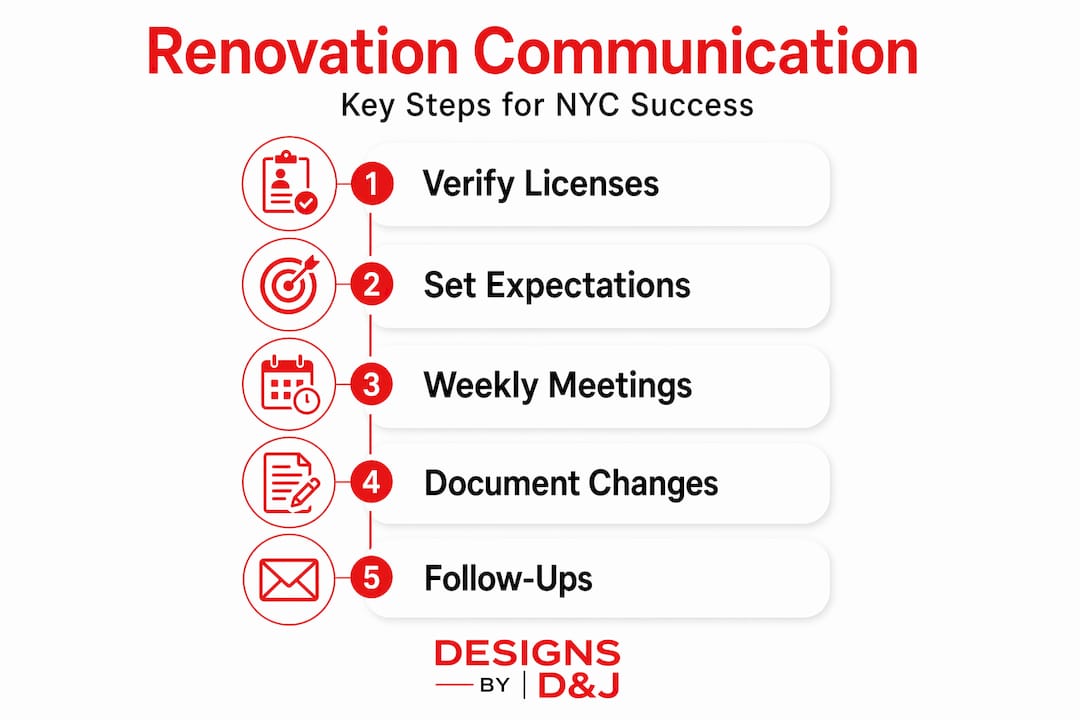
Verify licenses and permits first
Before you sign anything, confirm that your contractor holds an active license with the NYC Department of Buildings. NYC DOB permits are mandatory for most structural, electrical, and plumbing work, and a contractor who skips permits puts you at risk of stop-work orders and significant fines. This is not a formality. It is the foundation of every other conversation you will have.
Here is a quick reference for the most common NYC renovation requirements that affect communication and accountability:
| Requirement | What it means for you |
|---|---|
| DOB work permit | Contractor must pull this before starting most structural work |
| Active contractor license | Verify through NYC DOB BIS portal before signing any contract |
| Co-op or condo board approval | Written approval required before work begins in many buildings |
| Certificate of occupancy (if applicable) | Required for major alterations; confirm with your contractor upfront |
| Landmark Preservation Commission | Required for buildings in historic districts; adds approval time |
Establish your communication protocol at kickoff
Defining a single primary contact, your preferred communication channels, and a weekly meeting schedule at the very start prevents the confusion that comes from mixed messages and missed calls. Decide whether you prefer email for formal decisions, text for quick updates, and phone for urgent matters. Then write it down and make sure your contractor agrees to it.
Key items to lock in before work begins:
- Who is your primary point of contact on the contractor’s team?
- What is the expected response time for routine questions versus urgent issues?
- How will change orders be submitted, reviewed, and approved?
- What project management tool, if any, will be used to track progress?
Pro Tip: Ask your contractor how they handled a communication breakdown on a previous project. Their answer tells you more about their professionalism than any reference check.
Reviewing your NYC renovation questions on permits and timelines before your first contractor meeting will also help you ask sharper, more specific questions from the start.
Staying aligned throughout the project
Once work begins, the quality of your communication determines whether small problems stay small. Communication is the most overlooked factor in successful home construction projects, and that is especially true in NYC where timelines are tight and subcontractors, inspectors, and building managers all need to coordinate.
Run structured weekly meetings
Scheduled progress meetings prevent issues from festering. They keep everyone accountable and give you a regular opportunity to catch problems before they become expensive. Each meeting should follow a consistent structure.
A productive weekly meeting covers:
- Current progress against the agreed schedule
- Any work completed since the last meeting
- Upcoming tasks for the next seven days
- Open change orders and pending decisions
- Safety observations or site access issues
- Budget status and any cost variances
After each meeting, send a brief written summary to your contractor. This does not need to be formal. A simple email recap with bullet points and any agreed action items is enough. That paper trail protects both of you.
Choose the right channel for the right message
Not every message needs to be an email, and not every issue can wait for a weekly meeting. Clear escalation paths minimize delays and cost overruns, so agree on how different types of issues will be handled.
- Routine updates and schedule confirmations: text or project management app
- Formal decisions, change orders, and approvals: email with written confirmation
- Urgent site issues or safety concerns: phone call, followed immediately by written follow-up
- Disputes or contract-related matters: written letter or email referencing the specific contract clause
Pro Tip: Never make a verbal agreement about a change to scope or cost and leave it at that. Follow every verbal conversation with an email that says “As we discussed today…” and summarize what was agreed. This habit alone prevents most renovation disputes.
Document every decision and change order
Written summaries after discussions referencing the relevant contract sections are one of the most effective tools you have. When a homeowner says “we agreed to use the marble tile” and the contractor says “you said you were fine with ceramic,” the only thing that resolves that dispute is documentation. Change orders should include a description of the change, the cost impact, and the timeline impact. Both parties sign before any new work begins.
Avoiding the most common communication mistakes
Even well-prepared homeowners run into friction. Knowing what to watch for helps you respond quickly instead of letting problems compound.
Recognizing red flags early
Some communication problems signal deeper issues with how a contractor operates. Watch for these warning signs:
- Slow or inconsistent responses to routine questions
- Verbal promises that never make it into writing
- Resistance to weekly meetings or progress documentation
- Vague answers about permit status or subcontractor schedules
- Requests for large upfront payments without a clear draw schedule
If you see two or more of these patterns early in the project, address them directly and in writing. If the behavior continues, you have a contractual and practical problem that needs to be resolved before it gets worse.
What to do when things go wrong
| Problem | Recommended response |
|---|---|
| Contractor stops responding | Send a formal written notice referencing your contract’s communication requirements |
| Missed deadline with no explanation | Request a written explanation and revised schedule within a defined timeframe |
| Unexpected cost increase | Ask for itemized breakdown and compare against original contract and change orders |
| Work quality dispute | Document with photos, reference contract specs, and request a formal site review |
| Permit not pulled before work started | Stop work immediately and contact NYC DOB to understand your exposure |
Notice provisions in contracts are not adversarial tools. They are transparency mechanisms. Using them correctly keeps the relationship professional and the record clean. If you are choosing a contractor and want to know what questions to ask before signing, the 10 questions to ask a contractor resource from Designsbydandj is worth reviewing before you commit.
Pro Tip: If a contractor misses a milestone, do not just follow up verbally. Send a written notice that references the contract date, notes the delay, and asks for a revised completion date in writing. This creates a record without escalating the relationship unnecessarily.
Verifying progress and closing the loop
Strong communication does not end when the work looks done. The final phase of any NYC renovation requires the same rigor as the beginning.
As work nears completion, make sure you are doing the following:
- Conducting a formal walkthrough with your contractor before any final payment is released
- Confirming all permits have been closed and inspections passed with the NYC DOB
- Reviewing your punch list in writing and getting a signed commitment on completion dates for any remaining items
- Verifying that all subcontractors have been paid to avoid mechanics liens on your property
- Requesting copies of all warranties for materials and workmanship
Documented follow-ups after each phase provide accountability and help prevent disputes at project close. Do not release final payment until every item on the punch list is resolved and every permit is closed. That is your last point of leverage, and it is a legitimate one.
What I’ve learned from years of NYC renovations
After working through countless renovations across New York City, the one thing I keep coming back to is this: most project failures are communication failures. Not design failures. Not budget failures. Communication failures that started small and were never addressed.
Early budget and expectation discussions are the single most effective way to prevent costly revisions. I have seen homeowners spend weeks choosing tile and finishes without ever having a direct conversation about what happens if the project runs over budget. That conversation feels uncomfortable, but having it on day one is far less painful than having it on week eight when the walls are open.
What I have also learned is that the best contractor relationships are built on mutual respect, not just contracts. When you treat your contractor as a professional partner and communicate clearly and consistently, you get better work, faster responses, and more honest answers when problems arise. That does not mean being passive. It means being direct, organized, and fair.
The homeowners who have the smoothest renovations are not the ones who never face problems. They are the ones who catch problems early because they were paying attention and communicating well throughout.
— D&J
Work with a team that communicates from day one

At Designsbydandj, communication is not something we add at the end of the process. It is built into every step. As a family-owned design-build firm serving NYC homeowners, we start every project by understanding how you want to live in the space, what matters most to you, and what success actually looks like. From there, we provide clear estimates, honest timelines, and consistent updates so you always know where your project stands.
Our design-build service keeps design and construction under one roof, which means fewer handoffs, fewer miscommunications, and one accountable team from start to finish. Before your first meeting, download our free homeowner checklist to walk in prepared with the right questions and a clear picture of your priorities. When you are ready to talk, we are here.
FAQ
Why does communication fail in NYC renovations?
Communication often fails because homeowners and contractors never establish a formal protocol at the start. Without agreed channels, meeting schedules, and documentation habits, small misunderstandings compound quickly in NYC’s complex regulatory environment.
What should be documented in writing during a renovation?
Every decision, change order, approval, and cost adjustment should be documented in writing. Written records after discussions protect both parties and provide a clear reference point if disputes arise later.
How often should I meet with my contractor?
Weekly meetings are the standard best practice for active renovation projects. Each meeting should cover schedule progress, upcoming tasks, open change orders, and any budget variances, followed by a written summary.
What are the key permit requirements for NYC renovations?
Most structural, electrical, and plumbing work requires a NYC Department of Buildings permit pulled by your licensed contractor. Working without permits risks stop-work orders and fines, so confirm permit status before work begins.
How do I handle a contractor who stops communicating?
Send a formal written notice referencing your contract’s communication requirements and response time expectations. Clear escalation paths defined in your contract give you a professional, documented way to address the issue without immediately escalating to a dispute.



