

NYC historic building renovation rules require you to secure Landmarks Preservation Commission (LPC) approval before submitting any permit to the Department of Buildings (DOB) for exterior work on a landmarked property. The LPC and DOB serve distinct roles: the LPC evaluates historic appropriateness, while the DOB enforces building codes. As of 2026, the LPC oversees 38,000 buildings across 156 historic districts and 1,460 individual landmarks. That scope means a large share of New York property owners and developers face these regulations on nearly every exterior project. Understanding the permit types, approval sequences, and compliance requirements before you break ground is the fastest way to keep your project on schedule.
What permit types are required for renovating NYC historic buildings?
The LPC issues three permit types, and the one you need depends entirely on the scope of your work. Choosing the wrong category, or skipping the permit entirely, triggers automatic DOB rejection and potential fines.

| Permit Type | Typical Scope | Processing Time |
|---|---|---|
| Certificate of No Effect (CNE) | Work with no impact on historic features | 2–4 weeks |
| Permit for Minor Work (PMW) | Limited changes to historic features | 4–8 weeks |
| Certificate of Appropriateness (CofA) | Major alterations to exterior or character | 2–6+ months |
The CNE takes 2–4 weeks and covers work that does not affect any protected architectural feature, such as interior mechanical upgrades or roof equipment hidden from public view. The PMW covers limited exterior changes like replacing a single window with an in-kind match and typically clears in 4–8 weeks. The CofA is reserved for significant alterations, additions, or demolitions, and only 5% of applications require this level of review. That small percentage still represents hundreds of projects each year given the LPC’s jurisdiction.
- CNE: Best for work entirely inside the building or hidden from public view.
- PMW: Best for minor repairs, in-kind replacements, or small exterior changes.
- CofA: Required for new additions, facade overhauls, or any work that materially changes the building’s appearance.
Pro Tip: Request a pre-application meeting with LPC staff before filing. Staff will tell you which permit category fits your project, saving weeks of back-and-forth after submission.
Knowing your permit type early shapes your entire project schedule. A CNE project can move to DOB filing within a month. A CofA project may not reach DOB for six months or more. Build that reality into your budget and timeline from day one.
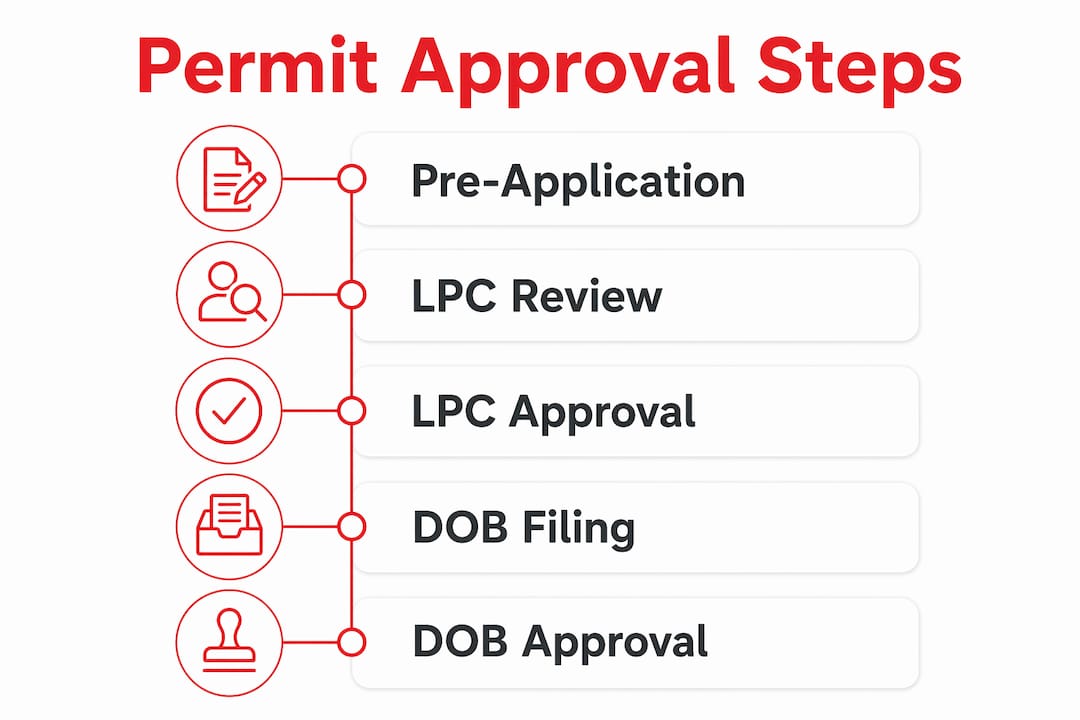
What is the approval sequence between the LPC and DOB?
LPC approval must come before DOB permit submission. This is not a suggestion. The DOB will reject or hold any application for a landmarked property that lacks prior LPC sign-off. Many property owners assume they can file with both agencies simultaneously. That assumption costs time and money.
The correct sequence works like this:
- Determine your permit type. Assess your scope of work and identify whether you need a CNE, PMW, or CofA before contacting either agency.
- Prepare LPC submission documents. Gather architectural drawings, material specifications, and photographs of existing conditions. Your architect should be familiar with LPC formatting requirements.
- Submit to the LPC and wait for approval. Processing times range from 2 weeks for a CNE to 6 or more months for a CofA. Do not file with the DOB during this period.
- Receive LPC approval documentation. The LPC issues a permit or approval letter. Keep this document ready for your DOB application package.
- Submit to the DOB with LPC approval attached. The DOB reviews your application for code compliance. With LPC approval in hand, the application moves forward without a hold.
- Obtain DOB permit and begin construction. Work may not start until both approvals are in place.
The LPC focuses on whether your proposed changes respect the building’s historic character. The DOB focuses on whether your plans meet current safety and building codes. These are separate reviews with separate standards, and neither agency substitutes for the other.
Pro Tip: Keep a digital copy of your LPC approval letter in your project folder and share it with your contractor before mobilization. A missing document on the job site can trigger a DOB stop-work order.
A common mistake is treating the LPC and DOB permit process as interchangeable. They are not. Skipping the sequence does not save time. It creates delays that are entirely avoidable with proper planning.
How to comply with preservation guidelines during exterior renovations
The LPC’s primary jurisdiction covers exterior work visible from public spaces. Interior renovations generally do not require LPC review unless the space is a designated interior landmark. That distinction matters because it means most kitchen, bathroom, and structural interior work can proceed under DOB rules alone.
For exterior work, the LPC expects you to match original materials and preserve existing architectural features wherever possible. The Secretary of the Interior’s Standards for Rehabilitation serve as the baseline framework the LPC uses to evaluate proposals. These standards favor repair over replacement and require that any new work be distinguishable from the original while remaining compatible in scale, material, and character.
Key exterior elements the LPC scrutinizes include:
- Facades: Masonry cleaning methods, repointing mortar, and surface coatings must match original materials in composition and appearance.
- Windows: Replacement windows must match the original in profile, material, and operation. Aluminum over wood sash is rarely approved.
- Doors and stoops: Original ironwork, stone treads, and door surrounds must be preserved or restored in kind.
- Railings and cornices: Decorative elements are protected. Removal requires a CofA.
Restoring original windows or masonry is favored over full replacement and speeds up LPC approval. That preference reflects the LPC’s core mandate: preservation, not prevention of change. Work with that mandate rather than against it.
Unauthorized work in a historic district carries fines up to $5,000 per violation plus full restoration costs. Repeat offenders face misdemeanor charges and up to one year of imprisonment. Those penalties apply per violation, meaning a single unpermitted project can generate multiple charges.
Income-producing properties may qualify for historic tax credits up to 40% of qualifying rehabilitation costs when work adheres to the Secretary of the Interior’s Standards. Verify eligibility early, because the credit applies only to costs incurred after the certification application is approved.
What are the steps for navigating public hearings and community board involvement?
A Certificate of Appropriateness triggers a public hearing before the full LPC commission. This is the most time-intensive part of the landmark renovation process, and preparation determines the outcome more than any other factor.
Follow these steps to manage the CofA process effectively:
- Engage a preservation architect early. The LPC expects detailed drawings, material samples, and a written narrative explaining how your proposal meets the Secretary of the Interior’s Standards. A qualified architect prepares this package correctly the first time.
- Present to your Community Board before the LPC hearing. Community Board presentations are not required, but they influence the LPC commission’s perception of your project. A supportive community board letter strengthens your application.
- Prepare a clear visual presentation. Use before-and-after renderings, material samples, and photographs of comparable approved projects. The commission responds to visual evidence.
- Attend the public hearing and respond to questions directly. Commission members ask specific questions about materials, scale, and reversibility. Prepare concise answers in advance.
- Follow up promptly after the hearing. If the commission requests modifications, submit revised drawings within their stated deadline. Delays reset your position in the review queue.
The CofA process can add 2–6 months to your project timeline before you reach the DOB. Factor that into your financing, contractor scheduling, and tenant agreements.
Pro Tip: Review recently approved CofA applications on the LPC’s public database before your hearing. Approved precedents from your block or district are the strongest argument you can bring to the commission.
Community feedback does not bind the LPC, but consistent neighborhood opposition creates friction. Proactive outreach to neighbors and local preservation groups before the hearing reduces that risk significantly.
Key takeaways
NYC historic building renovation rules require LPC approval before DOB filing, with permit type, approval sequence, and exterior compliance standards determining your project’s timeline and cost.
| Point | Details |
|---|---|
| LPC approval comes first | Submit to the LPC before filing any DOB permit application for landmarked properties. |
| Three permit types exist | CNE, PMW, and CofA differ in scope and processing time from 2 weeks to 6+ months. |
| Exterior work is the primary focus | The LPC regulates work visible from public spaces; most interior work bypasses LPC review. |
| Penalties are serious | Unauthorized work carries fines up to $5,000 per violation plus potential criminal charges. |
| Tax credits are available | Income-producing properties may qualify for up to 40% in historic rehabilitation tax credits. |
What working on NYC landmark properties has taught us
The biggest mistake property owners make is treating the LPC as an obstacle. It is not. The commission exists to protect the architectural character that makes New York neighborhoods worth investing in. When you approach the process as a partner rather than an adversary, approvals move faster and the finished project is better for it.
We have seen projects stall for months because an owner filed with the DOB before receiving LPC sign-off. We have also seen projects sail through the CofA process because the architect submitted complete drawings with material samples on the first attempt. The difference is preparation, not luck.
One thing most guides do not tell you: the LPC staff review is your best free resource. A pre-application meeting costs nothing and often reveals that your project qualifies for a CNE or PMW rather than a CofA. That single conversation can cut months off your schedule.
Restoration over replacement is not just an LPC preference. It is usually the smarter financial decision. Repairing original masonry or restoring historic windows costs less than sourcing custom replacements that meet LPC standards. The commission approves restoration faster, and the work holds up better over time.
If you are planning a brownstone restoration or a larger exterior renovation in a historic district, start the LPC process at least three months before you want to break ground. For a CofA project, six months is a more realistic buffer. Build that time into your contract, not as a contingency, but as a fixed phase.
— D&J
Designsbydandj guides you through NYC historic renovation compliance
Historic renovation in New York requires more than skilled construction. It requires a team that understands LPC permit types, DOB sequencing, and preservation standards before a single drawing is submitted.

Designsbydandj is a family-owned design-build remodeling firm in NYC with direct experience managing LPC and DOB approvals for landmarked properties. We handle the full process: architectural documentation, permit applications, community board presentations, and construction, all under one roof. You get clear timelines, honest cost estimates, and a team that communicates at every step. If your property sits in a historic district or carries individual landmark status, contact Designsbydandj to schedule a consultation and get your project moving in the right direction.
FAQ
What is the LPC, and does it apply to my property?
The NYC Landmarks Preservation Commission regulates exterior changes to over 38,000 buildings in 156 historic districts and 1,460 individual landmarks. Check the LPC’s online map to confirm whether your property falls under its jurisdiction.
Do I need LPC approval for interior renovations?
Interior renovations generally do not require LPC review unless the space is a designated interior landmark. The LPC focuses on exterior work visible from public spaces.
What happens if I do exterior work without LPC approval?
Unauthorized work in a historic district carries fines up to $5,000 per violation plus full restoration costs. Repeat offenders face misdemeanor charges and possible imprisonment.
How long does the LPC permit process take?
Processing times range from 2–4 weeks for a Certificate of No Effect to 2–6 months or more for a Certificate of Appropriateness. Only 5% of applications require the full CofA review.
Can I apply to the LPC and DOB at the same time?
No. LPC approval must be secured before submitting a DOB permit application. The DOB will reject or place on hold any application for a landmarked property that lacks prior LPC sign-off.



