

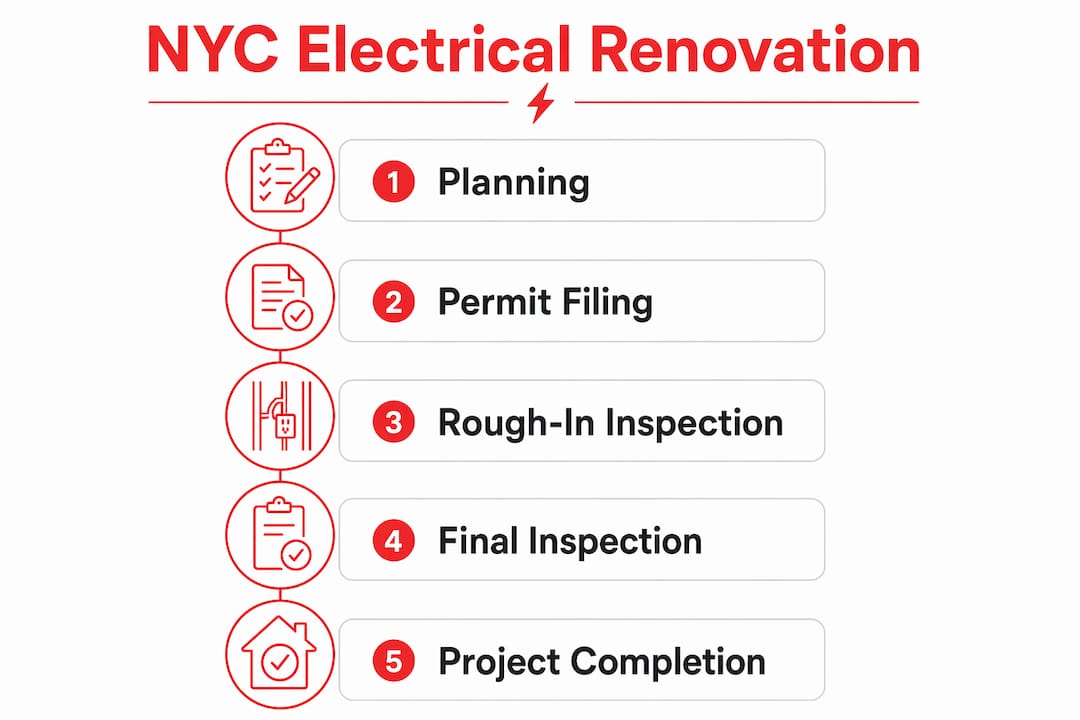
The NYC electrical upgrade renovation process is a structured, permit-driven sequence managed by the Department of Buildings (DOB) and executed exclusively by licensed Master Electricians. Every panel upgrade, circuit addition, or wiring alteration in a New York City home requires a filed permit, staged inspections, and final sign-off before walls can close or power can be restored. The 2025 NYC Electrical Code, effective December 21, 2025, expanded AFCI and GFCI requirements across nearly all living spaces, which directly increases the scope and cost of residential electrical renovation projects. If you are planning a renovation, understanding this process from day one is the difference between a smooth project and an expensive, wall-opening rework.
What permits and approvals does the NYC electrical upgrade renovation process require?
NYC electrical permits are required for all wiring additions, panel upgrades, or circuit changes beyond simple device replacements. Homeowners cannot self-permit electrical work in New York City. Only a licensed Master Electrician can file with the DOB on your behalf, and that filing must include a detailed scope covering circuits, panels, and wiring methods.
For apartment renovations involving multiple trades, the standard filing type is an ALT-2. ALT-2 projects typically take 4 to 8 weeks for DOB approval, often require a licensed architect or engineer to coordinate the filing, and are the most common permit path for NYC apartment electrical work. This timeline does not include co-op or condo board approval, which runs parallel and can add weeks to your start date.
Here is what triggers a mandatory electrical permit filing:
- Panel upgrades or service changes
- Addition of new circuits or subpanels
- Any alteration to existing wiring beyond replacing a device in kind
- Installation of EV charger circuits
- Basement or cellar electrical work involving reclassification of wet or damp locations
Permit fees scale with project scope. Minor projects cost $50 to $150 in permit fees, while major panel upgrades can reach $350 or more. All filings are submitted through DOB NOW, the city’s online permitting portal. Submitting an incomplete application is one of the most common causes of delay, so your Master Electrician’s paperwork must be thorough and code-compliant before submission.
| Scope | Permit Type | Typical Approval Time |
|---|---|---|
| Simple circuit addition | Standard electrical permit | 2 to 4 weeks |
| Panel upgrade with utility coordination | Standard electrical permit | 4 to 6 weeks |
| Multi-trade apartment renovation | ALT-2 filing | 4 to 8 weeks |
| Basement electrical reclassification | Standard electrical permit with wet/damp documentation | 4 to 6 weeks |
If you live in a co-op, add board approval to every timeline estimate. Our NYC co-op renovation checklist walks through exactly what building management and boards require before work can begin.
What inspections are required for NYC electrical upgrade projects?
NYC electrical inspections occur in two stages: a rough-in inspection before walls close and a final inspection after all devices are installed. Both stages are mandatory, and neither can be skipped or combined. Missing the rough-in inspection means you may need to reopen finished walls, which is a costly and avoidable mistake.
Here is what each stage covers:
- Rough-in inspection. The DOB inspector verifies wiring routing, cable support, conduit installation, and junction box placement. Walls must remain open. The inspector also checks that wiring methods match the location classification, which matters especially in basements.
- Final inspection. The inspector tests every outlet, switch, and breaker for proper function. GFCI and AFCI protection is verified at each required location. Panel labeling must be complete, accurate, and legible. The DOB requires 36 inches of clear space in front of every electrical panel clearance, and this must be declared in the permit application and confirmed at final.
- Wet and damp location checks. Basements and bathrooms receive additional scrutiny. Basement GFCI protection is required on most 125V receptacles, and wiring methods must match the DOB’s wet, damp, or dry classification for that specific space.
- Panel labeling and documentation. Every circuit must be labeled at the panel. Inspectors will fail a project for missing or incorrect labels, even if all wiring is correct.
- Sign-off. The inspector issues a sign-off only when all items pass. Without this, your project is not legally complete and cannot be closed out with the DOB.
Inspection failures most often result from incomplete AFCI or GFCI installation, improper panel labeling, or wiring methods that do not match the DOB’s location classification. Each failure triggers a re-inspection fee and extends your timeline.
Pro Tip: Schedule your rough-in inspection before any other trade closes walls. Coordinate directly with your Master Electrician to confirm the inspection date is locked in before drywall crews are on site. One missed inspection can set your entire project back by two to three weeks.
How do the 2025 NYC electrical code changes affect your renovation scope and budget?
The 2025 NYC Electrical Code expanded AFCI protection beyond bedrooms to cover nearly all habitable rooms, including living rooms, dining rooms, and home offices. GFCI protection requirements now extend to additional wet and damp locations and to general receptacles in areas previously exempt. These changes are not optional. Any permit filed under the 2025 code must meet the new standards, regardless of when the renovation was originally planned.
“Design revisions during filing are required if plans do not meet expanded AFCI and GFCI requirements, potentially increasing costs and delaying project start dates.” — NYC Electrical Code 2025
Here is a direct comparison of what changed:
| Protection Type | Pre-2025 Requirement | 2025 Requirement |
|---|---|---|
| AFCI coverage | Bedrooms only | All habitable rooms |
| GFCI coverage | Kitchens, bathrooms, outdoors | Expanded wet/damp locations and general receptacles |
| Basement circuits | GFCI on most 125V receptacles | Stricter wiring method requirements by location classification |
| Panel sizing | Based on existing load | Must accommodate expanded circuit counts for new protection devices |
For homeowners, the practical impact is straightforward. A renovation that might have required 10 AFCI breakers under the old code may now require 18 or more. Each AFCI breaker costs significantly more than a standard breaker, and the added circuit count can push you into a larger panel. Budget for this before you file, not after. Our 2025 NYC renovation costs guide breaks down how these code changes affect room-by-room electrical budgets in real numbers.
How to budget, plan timelines, and coordinate contractors for your electrical renovation
Realistic budgeting starts with understanding what licensed labor costs in New York City. Master Electricians charge $200 to $350 per hour, and that rate reflects the licensing, insurance, and DOB filing responsibilities they carry. Full apartment rewires run $25,000 to $55,000. Panel upgrades, including Con Edison utility coordination, typically cost $5,000 to $12,000. EV charger circuit installations vary by panel capacity and distance from the panel to the parking location.
Con Edison coordination is a critical path item that many homeowners overlook. The utility will not energize new service equipment until DOB rough-in approval is in hand. That means your panel upgrade timeline is directly tied to both the DOB inspection schedule and Con Edison’s scheduling queue. In practice, this adds one to three weeks to panel upgrade projects and must be factored into your overall renovation timeline from the start.
Key budgeting and coordination points to plan around:
- Permit fees. Budget $150 to $350 for electrical permits depending on scope, separate from your electrician’s labor and material costs.
- Material markups. Licensed electricians typically mark up materials 15 to 25 percent. Ask for a detailed breakdown in your estimate so you know what you are paying for.
- Inspection scheduling. DOB inspections are not instant. Build two to three weeks of buffer around each inspection stage in your project schedule.
- Co-op board approval. If you live in a co-op, submit your electrical scope to the building’s managing agent before filing with the DOB. Board review cycles run four to six weeks and cannot be shortened.
- General contractor coordination. Your electrician and GC must sequence work so rough-in inspection happens before any wall closure. Miscommunication here is the single most common cause of rework on NYC renovation projects.
Pro Tip: Submit a fully detailed permit application on the first attempt. Incomplete filings are rejected and restart the approval clock. Ask your Master Electrician to confirm that circuits, panel specs, and wiring methods are all documented before hitting submit in DOB NOW.
If you want a realistic cost estimate before committing to a scope, use the NYC renovation calculator to build a baseline budget that accounts for permit fees, labor, and code-driven scope additions.
Key takeaways
Successful NYC electrical renovations require permits filed by a licensed Master Electrician, two staged DOB inspections, and full compliance with the 2025 NYC Electrical Code before any project can be legally closed out.
| Point | Details |
|---|---|
| Permits are non-negotiable | Only a licensed Master Electrician can file; homeowner self-permitting is not allowed in NYC. |
| Two inspections are required | Rough-in before walls close and final after device installation; skipping either causes costly rework. |
| 2025 code expands scope | AFCI now covers all habitable rooms; budget for more breakers and a larger panel than you expect. |
| Con Edison is on the critical path | Utility coordination for panel upgrades adds one to three weeks; plan for it from day one. |
| Detailed filings prevent delays | Incomplete permit applications restart the approval clock; submit complete documentation the first time. |
What we have learned managing NYC electrical renovations
The homeowners who have the smoothest electrical renovations are the ones who treat the permit and inspection process as part of the design phase, not as an afterthought. We have seen projects where the electrical scope was planned without accounting for the 2025 AFCI requirements, and the result was a redesign mid-filing that pushed the start date back by six weeks and added $8,000 to the budget.
The most common mistake we see is hiring an electrician who is experienced but not current on NYC DOB filing requirements. A skilled electrician who does not file regularly in New York City will underestimate the documentation burden, and you will pay for that gap in knowledge through rejected applications and re-inspection fees. Always verify that your Master Electrician has active NYC DOB filing history, not just a valid license.
One thing we tell every client: the 2025 code changes are not a bureaucratic inconvenience. They reflect real safety improvements, particularly the expanded AFCI coverage that protects against arc faults in wiring that may be decades old in pre-war buildings. Budget for compliance as a feature of your renovation, not a penalty. When you understand what the DOB requires and why, the process feels far less stressful. Partnering with a team that knows how to choose the right renovation contractor and coordinate trades around inspection schedules makes a measurable difference in how your project runs.
— D&J
Let Designsbydandj manage your NYC electrical renovation from permit to final inspection
Designsbydandj is a family-owned design-build firm that handles NYC electrical upgrade renovations from initial scope planning through DOB permit filing, licensed electrician coordination, and final inspection sign-off. We know the 2025 NYC Electrical Code requirements, we work with licensed Master Electricians who file regularly with the DOB, and we build inspection schedules into every project timeline from day one.

You should not have to figure out ALT-2 filings, Con Edison coordination, and co-op board timelines on your own. Our design-build service covers every step with clear estimates, honest timelines, and consistent communication throughout. Contact Designsbydandj today to schedule a consultation and get a realistic plan for your electrical renovation.
FAQ
Who can file an electrical permit in NYC?
Only a licensed Master Electrician can file electrical permits with the NYC Department of Buildings. Homeowners cannot self-permit any wiring, panel, or circuit work beyond simple device replacements.
How long does the NYC electrical permit process take?
Standard electrical permits typically take two to four weeks for DOB approval. ALT-2 filings for multi-trade apartment renovations average four to eight weeks, not including co-op board review.
What does the 2025 NYC Electrical Code change for homeowners?
The 2025 code requires AFCI protection in all habitable rooms, not just bedrooms, and expands GFCI coverage to additional wet and damp locations. This increases circuit counts, panel sizing requirements, and overall renovation costs.
What causes electrical inspections to fail in NYC?
The most common causes are incomplete AFCI or GFCI installation, missing or incorrect panel labeling, and wiring methods that do not match the DOB’s location classification for the space being inspected.
Do I need a separate approval from my co-op board for electrical work?
Yes. Co-op boards require review and approval of your electrical scope before work begins, separate from the DOB permit process. Board review typically takes four to six weeks and runs parallel to your permit filing timeline.



