

The NYC brownstone restoration process is defined as a structured sequence of structural assessment, permit acquisition, masonry repair, and systems modernization that preserves a building’s historic character while bringing it up to current code. Homeowners working through this process deal with two regulatory bodies: the NYC Department of Buildings (DOB) and the Landmarks Preservation Commission (LPC). Getting both right from the start determines whether your project runs on schedule or stalls for months. This guide covers every phase, from your first inspection to final walkthrough, with real cost ranges and timeline expectations for 2026.
What permits does NYC brownstone restoration require?
DOB permits and LPC approvals are the two separate tracks every brownstone restoration must navigate, and confusing them is one of the most common and costly mistakes homeowners make.
The DOB issues two main permit types for renovation work:
- Alt-1 (Alteration Type 1): Required when you change the building’s use, occupancy, or egress. Converting a two-family to a single-family home triggers an Alt-1.
- Alt-2 (Alteration Type 2): Covers general renovations that do not change use or occupancy. Most facade repairs, kitchen gut renovations, and bathroom upgrades fall here.
- LPC approval: Required separately for any visible exterior alteration on a landmarked building or one within a historic district. This includes facade patching, stoop repairs, and window replacements.
To find out if your property requires LPC review, check the NYC LPC’s online map. If your block is in a designated historic district, every exterior change needs LPC sign-off before DOB will issue a permit.
The LPC review process requires you to submit documentation including drawings, material specifications, and physical test panels showing your proposed mortar mix and stone patch color. LPC review timelines range from a few weeks for minor work to several months for a Certificate of Appropriateness on major facade alterations. That gap can push your entire construction schedule back significantly if you do not plan for it.
Pro Tip: Submit your LPC application before finalizing your construction contract. Locking in a contractor start date before LPC approval arrives almost always leads to rescheduling fees and frustration.
Coordinating DOB and LPC timelines requires a contractor or architect who has done it before. An experienced team knows which submissions can run in parallel and which must be sequential.
How are brownstone facades and stoops actually restored?
Brownstone facade restoration follows a precise sequence. Skipping steps or using the wrong materials causes new damage within a few years, which is why material selection and application method matter as much as the labor itself.
The top historic brownstone restoration approaches all start with a thorough material assessment. A qualified mason or architect examines the stone for spalling, delamination, and crack patterns before any repair work begins. This assessment determines whether patching is viable or whether full stone replacement is necessary.
- Cut back deteriorated stone. Damaged sections are cut back to sound material using angle grinders or chisels, creating a clean substrate for the patch.
- Apply lime-based mortar patches. Restoration methods prioritize patching over full replacement, using lime-based mortars and color-matched aggregates. Lime mortar is softer than the stone, which lets it flex with the building and prevents cracking.
- Execute Dutchman repairs for larger voids. A Dutchman repair involves cutting a precise rectangular void and inserting a matching stone block. This technique preserves the original facade while replacing only the damaged section.
- Repoint mortar joints. Deteriorated mortar between stones is raked out and replaced with a period-appropriate lime mix. This step is critical because water infiltration through failed mortar joints is the primary cause of brownstone deterioration.
- Apply waterproof sealant. A breathable, penetrating sealant is applied after all repairs cure. This extends material life and blocks moisture without trapping vapor inside the stone.
Stoop restoration follows the same patching logic. Cornices, which are the decorative horizontal projections at the roofline, are often repaired with fiberglass or cast stone when original material is too deteriorated to patch.
| Repair Method | Best For | Material Used |
|---|---|---|
| Lime mortar patching | Small spalls and surface cracks | Lime putty, matched aggregate |
| Dutchman repair | Large voids or missing sections | Matched brownstone block |
| Full stone replacement | Severely deteriorated panels | New-cut brownstone or cast stone |
| Mortar repointing | Failed joints between stones | Lime-based mortar mix |
Pro Tip: In LPC districts, window replacement is often restricted. Restoring original wood sashes combined with high-performance interior storm windows is a code-compliant approach that also improves energy efficiency without altering the historic exterior.
What do brownstone restoration costs and timelines look like?
Cost and timeline are the two questions every homeowner asks first, and the honest answer is that both depend heavily on landmark status, scope of damage, and interior upgrade goals.
Facade restoration costs range from $30,000 to $80,000 for a standard project. Landmarked buildings requiring hand-tooled artisan finishes can exceed $120,000. That premium reflects the additional labor, material matching, and LPC compliance documentation involved.
Key cost factors include:
- Extent of facade damage: Surface spalling costs far less to address than deep delamination or structural cracking.
- Landmark status: LPC-required materials and finishes add cost at every phase.
- Interior scope: A full gut renovation adds significant cost on top of facade work. Upgrading electrical, plumbing, and HVAC systems is standard during a gut renovation and should be budgeted separately.
- Pre-purchase structural assessment: A structural evaluation by an architect or engineer typically costs $3,000–$8,000. That investment routinely prevents five-figure surprises during construction.
For timeline, gut renovation projects average 6–9 months from permit approval to completion. Facade-only projects run shorter, typically 2–4 months of active construction, but LPC review can add weeks or months to the front end.
For a realistic cost breakdown by scope, plan your budget in phases: assessment and permits first, then construction, then finishes and systems.
How do you manage a brownstone restoration from start to finish?
Managing a brownstone renovation requires a clear sequence. Improvising the order of steps leads to rework, permit violations, and budget overruns.
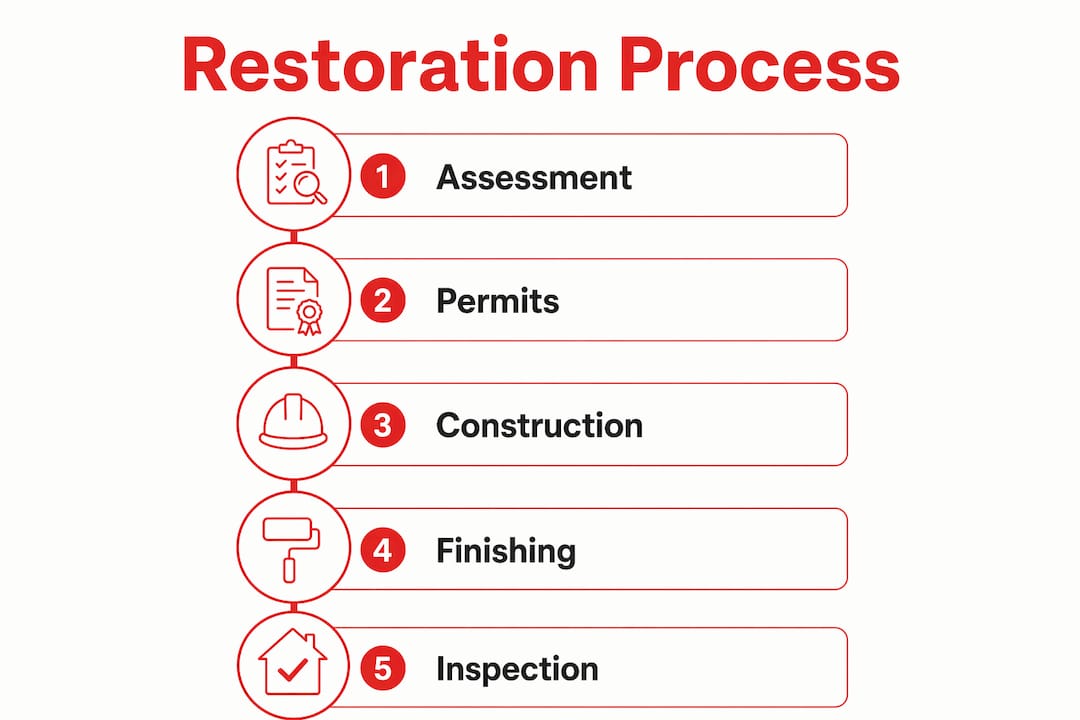
- Commission a structural inspection. Before signing any contracts, hire a licensed architect or structural engineer to assess the building. This report becomes the foundation of your restoration plan and your permit applications.
- Develop a customized restoration plan. Work with your design-build team to define scope, materials, and phasing. A good plan separates facade work from interior work so both tracks can progress without blocking each other.
- Submit permit applications early. File DOB and LPC applications as soon as drawings are complete. Do not wait for one approval before starting the other when submissions can run in parallel.
- Select and contract specialists. Brownstone restoration requires masons with specific experience in lime mortar work and historic stone repair. General contractors without that background routinely use Portland cement, which is too rigid for brownstone and causes new cracking within a few years.
- Manage inspections at each phase. DOB requires inspections at structural, rough-in, and final stages. Schedule these in advance to avoid delays between phases.
- Conduct a final walkthrough with your contractor. Review every repaired surface, test all new systems, and document any punch-list items in writing before making final payment.
Clear communication with your contractor throughout each phase prevents misaligned expectations. Weekly written updates on progress, budget, and schedule keep everyone accountable.
Why upgrading core systems matters as much as the facade
Facade restoration preserves the exterior, but the building’s long-term value depends equally on what is inside the walls. Prioritizing modernization of core systems over cosmetic upgrades is the single most important insight experienced contractors bring to brownstone projects.
Recommended system upgrades during a brownstone renovation include:
- Electrical: Upgrade to at least 200-amp service. Most pre-war brownstones run on 60-amp or 100-amp panels, which cannot support modern appliances, EV chargers, or heat pump systems safely.
- Plumbing: Replace galvanized steel pipes with copper or PEX. Galvanized pipes corrode from the inside, reducing water pressure and introducing rust into the water supply.
- HVAC: Install air-source heat pump mini-splits to phase out fossil fuel heating. This upgrade aligns with NYC’s Local Law 154, which restricts fossil fuel combustion equipment in new and substantially renovated buildings.
- Insulation: Spray closed-cell foam on interior wall surfaces to raise thermal R-values from the typical R-3 to R-5 range up to R-15 to R-20. This upgrade dramatically reduces heating and cooling costs without touching the historic exterior.
Pro Tip: Run all rough-in work for electrical, plumbing, and HVAC before closing up walls. Doing it in the right order saves you from opening finished walls later, which is one of the most avoidable costs in any renovation.
Key takeaways
A successful brownstone restoration in NYC requires coordinating DOB permits, LPC approvals, expert masonry techniques, and system upgrades in the right sequence to protect both historic character and long-term value.
| Point | Details |
|---|---|
| Permits come first | File DOB and LPC applications before signing a contractor start date to avoid costly rescheduling. |
| Lime mortar is non-negotiable | Portland cement is too rigid for brownstone and causes new cracking; always use lime-based mixes. |
| Budget for landmark premiums | LPC-required finishes can push facade costs past $120,000 on landmarked properties. |
| Systems upgrades protect your investment | Upgrading electrical, plumbing, and HVAC during restoration prevents far more expensive repairs later. |
| Pre-purchase assessments save money | A $3,000–$8,000 structural evaluation prevents five-figure surprises during active construction. |
What we’ve learned after years of brownstone restorations in NYC
The part of brownstone restoration that surprises homeowners most is not the cost or the timeline. It is how much the permit process shapes every other decision. We have seen projects where a homeowner locked in a contractor, set a move-in date, and then waited three months for LPC approval on a facade detail that was not even the main scope of work. That sequence is avoidable, but only if you treat permits as the first phase of construction, not an administrative afterthought.
The other thing we have learned is that the facade is not always the most urgent problem. We have walked into brownstones with beautiful stoops and original cornices sitting on top of 60-year-old galvanized plumbing and a 60-amp electrical panel. The exterior looked fine. The interior was a liability. Prioritizing systems over aesthetics is the right call every time, even when it is a harder sell to a homeowner who fell in love with the original woodwork.
What actually makes a brownstone restoration succeed is a team that knows the regulatory environment, respects the material, and communicates clearly at every step. Experienced masons who understand lime mortar behavior, architects who have navigated LPC review dozens of times, and a project manager who keeps the schedule honest. That combination is rarer than it should be in NYC, and it is the difference between a project that finishes on time and one that drags into its second year.
— D&J
Ready to start your brownstone restoration?
Brownstone restoration in NYC is one of the most rewarding projects a homeowner can undertake. It is also one of the most complex. Getting the permits right, selecting the correct materials, and managing the construction sequence requires experience that goes beyond general contracting.

Designsbydandj is a family-owned design-build firm with direct experience managing brownstone renovation projects across Brooklyn and NYC. We handle permit coordination with the DOB and LPC, connect you with skilled masons who specialize in historic stonework, and keep you informed at every phase with clear timelines and honest budgets. If you are planning a restoration and want a team that treats your home with the same care you do, explore our full renovation services or reach out to schedule a consultation.
FAQ
What is the difference between DOB and LPC permits?
The DOB issues permits for structural and interior work, while the LPC approves any visible exterior changes on landmarked buildings or properties in historic districts. Both are required for most full brownstone restorations.
How long does a brownstone restoration take?
Gut renovations average 6–9 months of active construction. LPC review for facade work can add weeks to several months on the front end, depending on the complexity of the alterations.
Can i replace my brownstone windows in a historic district?
Full window replacement is often restricted by the LPC. Restoring original wood sashes and adding interior storm windows is the approved approach that preserves historic character while improving energy performance.
What is a dutchman repair?
A Dutchman repair involves cutting a precise rectangular void in damaged brownstone and inserting a matching stone block. It is the preferred method for repairing large voids while preserving the original facade.
Do i need a structural assessment before starting restoration?
A pre-purchase or pre-renovation structural assessment is strongly recommended. Evaluations typically cost $3,000–$8,000 and regularly prevent unexpected expenses that can run far higher during active construction.



