

Remediation is defined as the mandatory process of removing hazardous conditions, such as water damage, mold, asbestos, or lead, before any reconstruction work can legally begin. Understanding how remediation affects renovation timeline planning is the single most important factor separating projects that finish on schedule from those that spiral into months of unexpected delays. Restoration and remediation typically start within 24–72 hours of a loss event and must be fully documented and cleared before a single wall goes back up. Skipping or rushing this phase does not save time. It resets the entire project clock.
How remediation affects renovation timeline: the key phases
Remediation is not one task. It is a sequence of verified steps, each of which must be completed before the next begins. Every phase adds time to your renovation schedule, and each one exists for a specific, non-negotiable reason.
The major phases that directly influence your renovation timing include:
- Initial damage assessment and documentation. A licensed inspector evaluates the full scope of damage. This documentation becomes the foundation for insurance claims, permit applications, and contractor scopes. Skipping a thorough assessment here causes scope changes later, which are far more expensive.
- Drying, dehumidification, and moisture control. Water damage requires industrial drying equipment running continuously, often for 3–5 days or longer depending on the materials affected. Reconstruction cannot begin before clearance testing confirms moisture levels are within acceptable limits. Starting too early traps moisture inside walls and leads to mold growth, warranty callbacks, and a full restart.
- Hazardous material abatement. Asbestos, lead, and mold each require separate abatement protocols under federal and state regulations. The EPA’s Renovation, Repair and Painting (RRP) program governs lead work in pre-1978 homes, and it operates under entirely different rules than lead abatement. Confusing the two programs has shut down projects and triggered legal penalties.
- Third-party testing and clearance. An independent inspector, not your contractor, must verify that remediation is complete. Insurers and contractors require this clearance before approving any reconstruction scope.
- Insurance approval. After clearance, your insurer reviews the documentation before releasing funds for reconstruction. This review adds days or weeks to your renovation schedule after remediation, depending on claim complexity.
Pro Tip: Request your third-party clearance report in writing before your contractor orders any materials. That single document is what unlocks your reconstruction phase and protects you from future liability.
How does regulatory compliance affect the renovation schedule?
Permits are a fixed, non-negotiable constraint on every renovation schedule after remediation. Residential permit processing takes 5–30 business days on average, and that window cannot be compressed regardless of how urgently you need to move forward. That means a project waiting on permits after remediation clearance can sit idle for up to six weeks before a single tool is picked up.
For larger or more complex projects, the timeline grows significantly. Building Safety Regulator approvals for large-scale remediation work can extend project timelines by months even when contractors are ready to proceed. Regulatory bodies are working to improve processing speed, but homeowners should plan for these delays rather than assume they will not apply.
The table below shows how permit timing stacks against remediation phases in a typical residential project.
| Phase | Typical duration | Key constraint |
|---|---|---|
| Damage assessment | 1–3 days | Must precede all other phases |
| Drying and moisture control | 3–10 days | Clearance testing required before next phase |
| Hazardous material abatement | 3–14 days | Regulated by EPA RRP and state agencies |
| Third-party clearance testing | 1–5 days | Required by insurers and contractors |
| Permit processing (residential) | 5–30 business days | Fixed; cannot be shortened |
| Complex regulatory review | Up to 16–20 weeks | Applies to larger or high-risk projects |
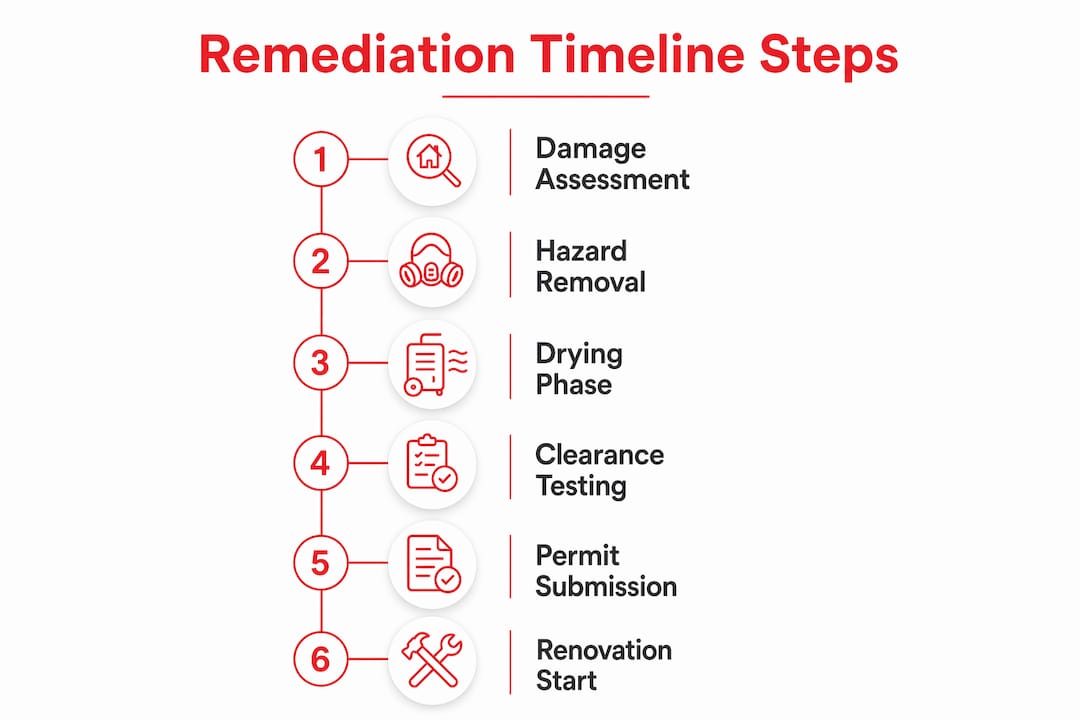
The most effective way to reduce total project time is parallel permit submission. Submitting permits concurrently with active remediation phases, rather than waiting until remediation is fully complete, can eliminate weeks of idle time from your renovation schedule.
Pro Tip: Ask your contractor or project manager to file permit applications the moment your remediation scope is documented. You do not need clearance in hand to begin the permit process in most jurisdictions.
What happens when hazards are discovered mid-renovation?
Unexpected hazardous materials discovered during active renovation work cause the most damaging delays a homeowner can face. A stop-work order issued mid-project does not pause the timeline. It resets it. Emergency abatement protocols must be activated, workers must vacate the affected area, and the entire project sequence must be re-evaluated.
Real-world examples show how severe this can get. The Seymour Centre renovation was delayed after asbestos and heritage complications were discovered mid-project, pushing costs to £44 million and delaying reopening by a full year. While that is a large institutional project, the same dynamic plays out in residential renovations every day, just at a smaller scale.
The most common mid-project discoveries that trigger delays include:
- Asbestos in floor tiles, pipe insulation, or ceiling texture in homes built before 1980
- Lead paint beneath multiple layers of newer paint in pre-1978 properties
- Hidden mold behind walls, under flooring, or inside HVAC cavities
- Structural water damage not visible during the initial assessment
Addressing hazardous materials upfront through a pre-renovation environmental survey is the most reliable way to avoid these scenarios. An environmental survey before renovation identifies asbestos, lead, and mold before demolition begins, giving you a complete picture of what abatement work is required. That knowledge lets you build an accurate timeline and budget from day one, rather than discovering problems after walls are already open.
How can homeowners integrate remediation into renovation planning?
Proactive planning is the difference between a renovation that runs on schedule and one that drags on for months. The steps below reflect best practices used by experienced design-build firms to keep remediation and renovation phases aligned.
- Commission an environmental survey before demolition. Test for asbestos, lead, and mold before any work begins. This single step eliminates the most common source of mid-project stop-work orders and gives your contractor a complete scope to price accurately.
- Submit permits in parallel with remediation. Do not wait for a clearance certificate to file your permit application. Work with your contractor to identify which permits can be submitted during active remediation phases to reduce total idle time.
- Establish clear communication between all parties. Your remediation team, renovation contractor, and insurance adjuster must share documentation in real time. Delays in information transfer between these groups are a leading cause of renovation cost overruns that could have been avoided.
- Build buffer time into your renovation schedule. Even a well-planned project can encounter regulatory delays or extended drying times. A realistic schedule includes contingency days for permit processing, re-testing, and insurer review. Understanding realistic renovation timelines by project type helps you set accurate expectations from the start.
- Clarify regulatory distinctions before work begins. The EPA distinguishes between lead abatement and the RRP program, and confusing these two programs creates compliance risks that can shut down a project. Confirm which regulations apply to your specific property and scope before signing any contracts.
Clear, proactive response plans are critical to avoiding disputes and regulatory delays throughout the remediation and renovation process. Ambiguous project scopes and evolving compliance requirements can extend remediation deadlines significantly, even when all parties are acting in good faith.
Key Takeaways
Remediation is a mandatory, sequenced prerequisite to renovation, and every phase, from drying to third-party clearance to permit processing, adds fixed, non-negotiable time to your project schedule.
| Point | Details |
|---|---|
| Remediation must precede reconstruction | Third-party clearance is required before any rebuild work can legally begin. |
| Permits run on fixed timelines | Residential permits take 5–30 business days; submit them during remediation, not after. |
| Mid-project discoveries are the costliest delays | Pre-renovation environmental surveys eliminate the most common source of stop-work orders. |
| Parallel processing saves weeks | Filing permits concurrently with active remediation phases reduces total idle time significantly. |
| Regulatory distinctions matter | EPA lead abatement and RRP programs are separate; confusing them creates compliance risks. |
What we’ve learned from managing remediation-dependent renovations
The most common misconception I see from homeowners is that remediation is a delay. It is not. It is the foundation the renovation is built on. When you skip it or rush it, you are not saving time. You are borrowing it from a future crisis that will cost far more to resolve.
What actually causes the worst delays is not the remediation itself. It is the surprise. A homeowner who discovers asbestos on demo day faces a stop-work order, emergency abatement costs, re-sequencing of every trade, and a permit process that may need to restart. That same homeowner, had they done an environmental survey three weeks earlier, would have absorbed the abatement into the original schedule without drama.
The other thing I have seen consistently is that the permit timeline catches people off guard. Homeowners assume permits are a formality that happens quickly. When a residential permit takes four to six weeks, and the contractor is standing by, that is real money in carrying costs, temporary housing, and lost time. Submitting permits the moment your remediation scope is documented is not a workaround. It is standard practice for any well-run project.
Transparency about these realities is what Designsbydandj is built on. We do not tell clients what they want to hear about timelines. We tell them what is true, and we plan around it together.
— D&J
Planning your renovation with Designsbydandj
Remediation adds real time to any renovation project. The good news is that with the right planning, most of that time can be accounted for from the start.

Designsbydandj is a family-owned design-build firm in NYC that manages the full project sequence, from pre-renovation environmental assessments to permit filing, remediation coordination, and final construction. We build remediation phases directly into your project schedule so nothing catches you off guard. Our team handles communication between your remediation crew, your insurer, and your renovation trades so you are never left waiting on information. If you want a renovation that feels organized and stress-free, even when the building throws surprises at you, reach out to our team to get started.
FAQ
How long does remediation add to a renovation timeline?
Remediation typically adds 2–6 weeks to a renovation timeline, depending on the type and extent of hazards found. Permit processing alone can add 5–30 business days on top of active remediation work.
Can renovation work start before remediation is complete?
No. Reconstruction cannot begin before third-party clearance testing confirms remediation is complete. Starting early risks trapped moisture, mold growth, and warranty voidance.
What is the difference between lead abatement and the EPA RRP program?
Lead abatement permanently removes lead hazards and follows one set of regulations. The EPA’s Renovation, Repair and Painting program follows a separate set of standards. Confusing the two can result in compliance violations and project shutdowns.
How can homeowners reduce remediation delays in renovations?
Commission an environmental survey before demolition, submit permits during active remediation phases rather than after, and maintain real-time communication between your remediation team, contractor, and insurer.
Does insurance cover remediation costs and the resulting delays?
Coverage varies by policy and the cause of damage. Most homeowner policies cover sudden water damage remediation but may exclude mold or pre-existing hazardous materials. Review your policy with your adjuster before remediation begins.
Recommended
- How Long Does a NYC Renovation Take? (Realistic Timelines by Project Type) – Designs by D and J
- NYC Renovation Questions Answered | Cost, Permits, Timeline Guide – Designs by D and J
- Gut Renovation vs. Partial Renovation in NYC: Which Is Right for Your Project? – Designs by D and J
- What Is a Renovation Scope? A Homeowner’s Guide