

An environmental survey renovation is a professional inspection that identifies hazardous materials inside a building before any renovation work begins. This process protects workers, residents, and property owners from toxic exposure and legal liability. In New York, buildings constructed before 2000 almost always require this inspection before permits are issued. Knowing what the survey covers, how it works, and how it differs from a Phase I Environmental Site Assessment (ESA) gives you a real advantage when planning your project.
What is an environmental survey renovation and why does it matter?
An environmental survey for renovation is a risk identification tool, not a clearance certificate. Its core purpose is to find hazardous materials that could become dangerous the moment a contractor cuts, drills, or removes them. The industry standard term for this inspection is a Hazardous Building Materials (HBM) survey, and you will see that phrase used interchangeably with “pre-renovation environmental survey” throughout the permitting process.
New York buildings built before 2000 carry a high probability of containing regulated substances. OSHA and New York City Department of Buildings regulations both require documented surveys before permits are approved for work that disturbs existing materials. Skipping this step does not make the hazards disappear. It shifts the legal and financial risk entirely onto you.
What hazards does a pre-renovation environmental survey find?
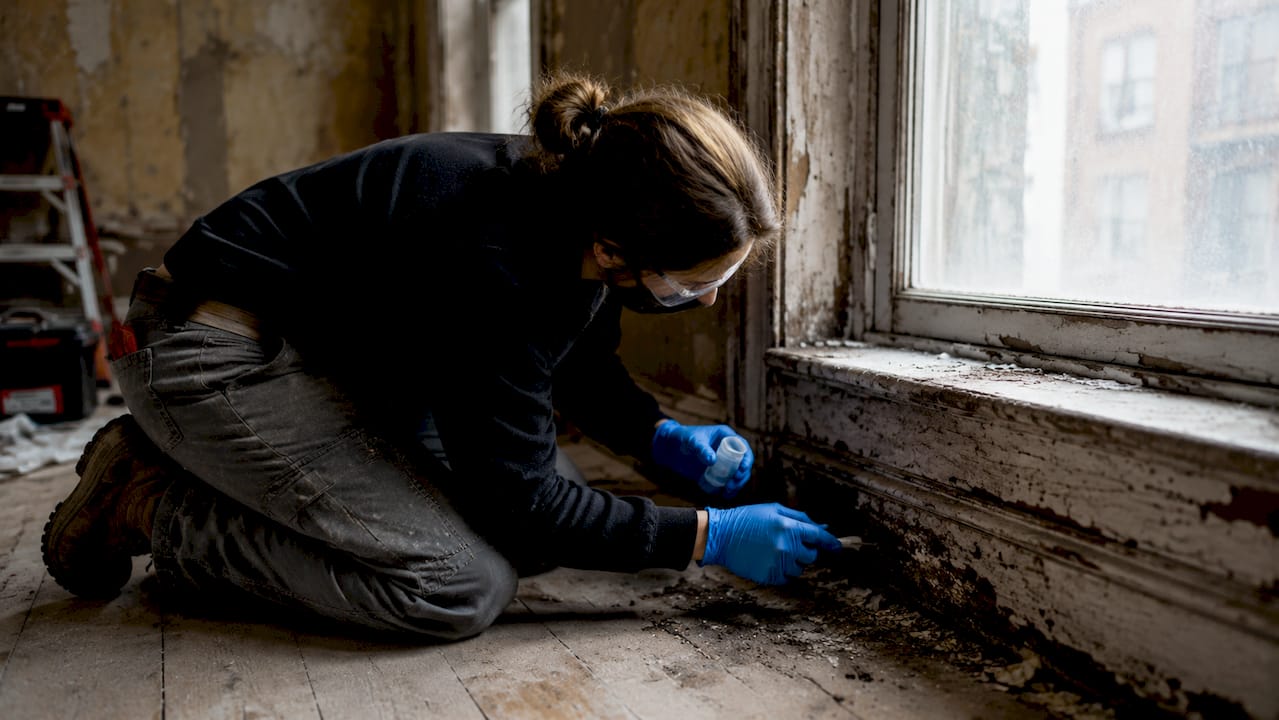
The most common substances identified in a hazardous building materials survey include asbestos, lead-based paint, polychlorinated biphenyls (PCBs), crystalline silica, mold, and mercury. Each of these materials was widely used in construction before modern safety standards existed. Each becomes a health threat when disturbed.
Asbestos appears in floor tiles, pipe insulation, ceiling texture, roofing felt, and caulking around windows. Lead-based paint covers walls, trim, and doors in most pre-1978 buildings. PCBs show up in older caulking compounds and fluorescent light ballasts. Silica dust is released when concrete, brick, or mortar is cut or ground. These are not rare findings in New York renovation projects. They are the norm.
Surveyors collect samples from suspected materials and send them to an accredited laboratory for analysis. Intrusive testing involves opening walls, lifting floorboards, and accessing ceiling cavities to reach materials that are not visible from the surface. Non-intrusive inspection covers only accessible surfaces and is not sufficient before renovation work that disturbs building materials.
- Asbestos: Floor tiles, pipe wrap, spray-applied fireproofing, roof shingles, and joint compound
- Lead-based paint: Interior and exterior painted surfaces, especially in pre-1978 buildings
- PCBs: Window caulking, expansion joint sealants, and electrical equipment in buildings constructed between 1950 and 1979
- Silica: Concrete, brick, mortar, and tile grout disturbed during demolition or cutting
- Mold: Areas with past or current moisture intrusion, including basements and behind wall assemblies
- Mercury: Thermostats, fluorescent lamps, and older switches
Pro Tip: Request that your environmental consultant test all materials scheduled for removal, not just the ones that look suspicious. Materials appearing intact are often wrongly assumed safe, and the risk appears the moment renovation work disturbs them.
How is an environmental survey conducted step by step?
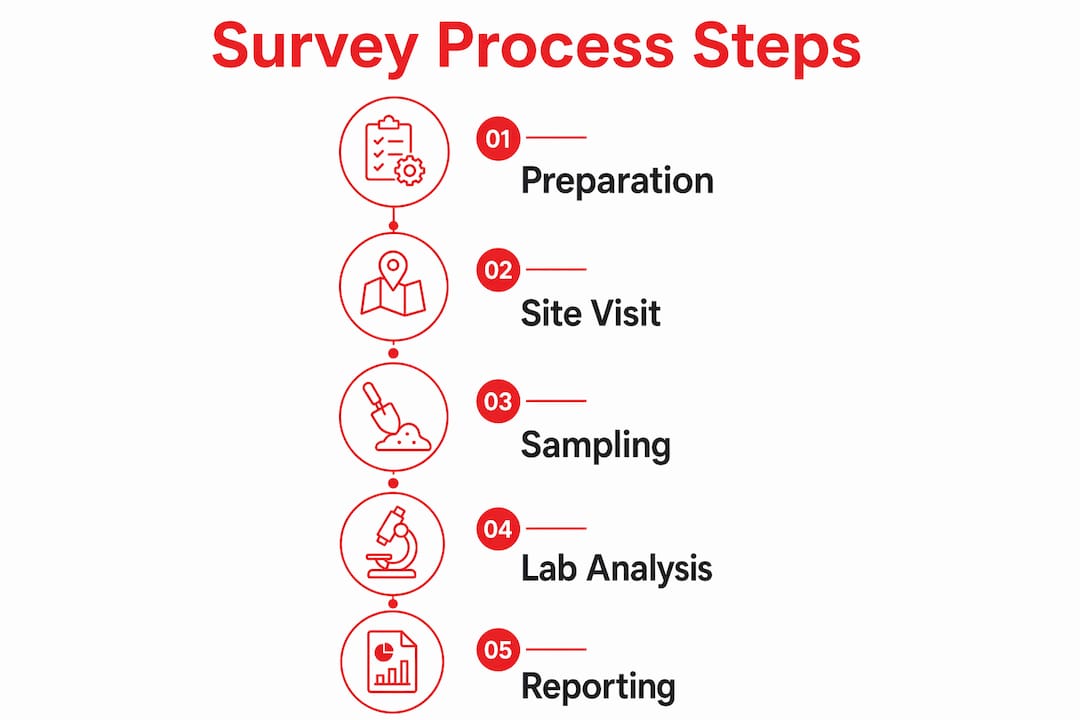
A well-executed hazardous materials survey follows a clear three-phase process. Understanding each phase helps you set realistic expectations and ask the right questions when hiring a consultant.
Records review. The consultant collects building permits, construction drawings, prior inspection reports, and maintenance records. This background research identifies the building’s age, original materials, and any previously documented hazards.
Physical site inspection. The surveyor walks every area of the building scheduled for renovation. For a pre-renovation survey, this must be an intrusive inspection. That means opening walls, pulling up flooring, and accessing above-ceiling spaces to collect samples from materials that will be disturbed. A non-intrusive survey is designed for ongoing management of known materials, not for permit approval before demolition or renovation.
Laboratory analysis. Collected samples go to an accredited lab. Results confirm the presence, concentration, and condition of regulated substances. Turnaround time typically runs three to five business days for standard analysis.
Report delivery. The final report documents all findings, lab results, material locations, and condition assessments. A quality report also includes abatement recommendations and cost estimates for removal, encapsulation, or management of each identified hazard.
Integration into project planning. Survey results feed directly into your renovation design, permit applications, and contractor scope of work. Abatement must be completed before general construction begins in affected areas.
“Defining a clear scope of work that mandates inspection of hidden areas is crucial. Without specifying intrusive survey requirements, reports may be incomplete and fail to meet permit approval needs.” — Crucial Environmental
The ASTM E1527-21 standard governs Phase I ESAs, but many environmental consultants apply similar due diligence principles to hazardous materials surveys. Scheduling the survey during the early design phase, before permit submission, protects your timeline and your budget.
How does an environmental survey differ from a Phase I ESA?
This is one of the most common points of confusion for New York homeowners and developers. A hazardous materials survey and a Phase I Environmental Site Assessment are two different tools that serve different purposes.
A Phase I ESA assesses property contamination in soil and groundwater. It is conducted without sampling or intrusive testing. The process relies on a site reconnaissance, records review, and interviews to identify recognized environmental conditions (RECs). Phase I ESAs are required under federal law CERCLA and are most commonly triggered by property transactions, financing, or large-scale development.
A hazardous materials survey focuses on what is inside the building. It is intrusive, sample-based, and focused on materials that will be disturbed during renovation. The two assessments address completely different risks and are required in different circumstances.
| Feature | Hazardous Materials Survey | Phase I ESA |
|---|---|---|
| Focus | Materials inside the building | Soil and groundwater contamination |
| Method | Intrusive sampling and lab analysis | Non-intrusive records review and observation |
| Triggered by | Pre-renovation permit requirements | Property transfers, financing, development |
| Regulatory framework | OSHA, NYC DOB, EPA | CERCLA, ASTM E1527-21 |
| Output | Abatement plan with cost estimates | Recognized environmental conditions report |
The site reconnaissance in a Phase I ESA is an observational assessment. It requires experienced professionals to synthesize records and observations into reliable findings. A checklist-only approach by junior staff misses key risks and creates false confidence. The same principle applies to hazardous materials surveys. Experience and thoroughness matter.
Why environmental surveys are critical for New York renovation projects
Buildings in New York built before 2000 require pre-renovation environmental surveys under OSHA and local regulations before permits are issued. This is not optional. It is a legal prerequisite for most renovation work in older structures across the five boroughs.
Survey costs range from $330 to $1,650 depending on property size and testing intensity. That range reflects the difference between a small residential bathroom renovation and a full gut renovation of a multi-family building. The cost of the survey is small compared to the cost of discovering hazardous materials mid-construction.
Late discovery of hazardous materials causes permit hold-ups, contractor work stoppages, and costly redesigns. A project that uncovers asbestos-containing floor tiles after demolition has already begun faces mandatory abatement, potential stop-work orders, and significant schedule delays. These delays affect your NYC renovation timeline and can push costs well beyond the original budget.
- Schedule the survey before finalizing your renovation design, not after
- Use a certified industrial hygienist or licensed environmental consultant
- Confirm the consultant carries professional liability insurance
- Request a report that includes abatement cost estimates, not just findings
- Share the report with your architect and contractor before permit submission
Pro Tip: Ask your environmental consultant to attend a pre-construction meeting with your contractor. Direct communication between the consultant and the construction team reduces the risk of abatement scope being misunderstood or skipped.
How to prepare for and use your environmental survey results
Selecting the right environmental consultant is the first decision that shapes everything else. Look for a licensed industrial hygienist or a firm with documented experience in New York City renovation projects. Verify their accreditation and ask for references from projects similar in scope to yours.
When the report arrives, read the abatement recommendations before you review the lab results. The recommendations tell you what needs to happen before construction can proceed. The lab results tell you why. A quality report functions as a renovation planning roadmap, with clear guidance on which materials require removal, which can be encapsulated, and which can remain undisturbed.
Integrate the survey findings into your permit application package. New York City Department of Buildings reviewers expect to see hazardous material documentation for older buildings. Submitting a complete package the first time reduces back-and-forth and speeds approval. For guidance on communicating with your contractor about abatement requirements, clear written documentation of the survey scope and findings is the most effective tool.
Ignoring survey results carries serious consequences. Property owners who proceed with renovation without addressing identified hazards face OSHA fines, stop-work orders, and potential civil liability if workers or occupants are exposed. The survey is not a formality. It is the foundation of a safe and legally compliant project.
Key takeaways
A pre-renovation environmental survey is a legal requirement and a practical necessity for any New York building built before 2000, covering hazardous materials from asbestos to lead that become dangerous the moment renovation work disturbs them.
| Point | Details |
|---|---|
| Survey vs. Phase I ESA | Hazardous materials surveys are intrusive and building-focused; Phase I ESAs assess soil and groundwater without sampling. |
| Cost range | Pre-renovation surveys cost $330–$1,650 depending on property size and testing scope. |
| Timing matters | Schedule the survey during early design, before permit submission, to avoid costly delays. |
| Report quality | Demand abatement recommendations and cost estimates, not just lab results, from your consultant. |
| Legal requirement | New York buildings built before 2000 require documented surveys before renovation permits are issued. |
What we’ve learned from New York renovation projects
After working on renovations across New York City, one pattern stands out clearly. Homeowners and developers who treat the environmental survey as a box to check almost always pay more in the end. Those who treat it as a planning tool come out ahead.
The most expensive surprises we see on job sites come from asbestos-containing materials found after demolition has started. A stop-work order in New York is not a minor inconvenience. It can freeze a project for weeks while abatement contractors are scheduled, permits are amended, and the Department of Buildings reviews updated documentation. That delay costs real money and real stress.
There is also a persistent myth that materials look safe if they look intact. A floor tile with no visible damage can still release asbestos fibers the moment a contractor scores it with a grinder. You cannot assess hazardous materials by looking at them. Testing is the only reliable answer.
We encourage every client to view the survey fee as part of the construction budget, not as an add-on. A thorough report from a qualified consultant gives your architect and contractor the information they need to design and build safely. It gives you the documentation you need to pull permits without delays. And it gives everyone on the project confidence that the work is being done right.
The environmental survey is not the most exciting part of a renovation. But it is one of the most consequential decisions you make before the first wall comes down.
— D&J
Start your New York renovation the right way with Designsbydandj
Designsbydandj is a family-owned design-build firm serving homeowners and developers across New York City. We build environmental survey findings directly into our project planning process, so abatement requirements, permit timelines, and construction schedules all align from day one. You get clear estimates, honest timelines, and a team that handles the details so you do not have to.

If you are planning a renovation in a pre-2000 building, the survey is your starting point. Designsbydandj coordinates with licensed environmental consultants and integrates their findings into every phase of the design-build process. Explore our design-build remodeling services to see how we keep your project safe, compliant, and on track from the first inspection to the final walkthrough.
FAQ
What is a pre-renovation environmental survey?
A pre-renovation environmental survey is a professional inspection that identifies hazardous materials such as asbestos, lead-based paint, and PCBs inside a building before renovation work begins. It is required by OSHA and New York City regulations for most older buildings.
How much does an environmental survey cost in New York?
Pre-renovation environmental surveys cost between $330 and $1,650 depending on the size of the property and the scope of testing required.
Do I need a survey before renovating a pre-2000 building in New York?
Yes. New York buildings built before 2000 require a documented pre-renovation environmental survey before permits are issued for work that disturbs existing building materials.
What is the difference between a hazardous materials survey and a Phase I ESA?
A hazardous materials survey is an intrusive, sample-based inspection of materials inside a building. A Phase I ESA is a non-intrusive assessment of soil and groundwater contamination, typically required for property transactions rather than renovation permits.
What should a good environmental survey report include?
A quality report includes lab results, material locations, condition assessments, and abatement recommendations with cost estimates. Without abatement guidance and budget figures, the report cannot serve as a usable planning tool for your renovation project.



