

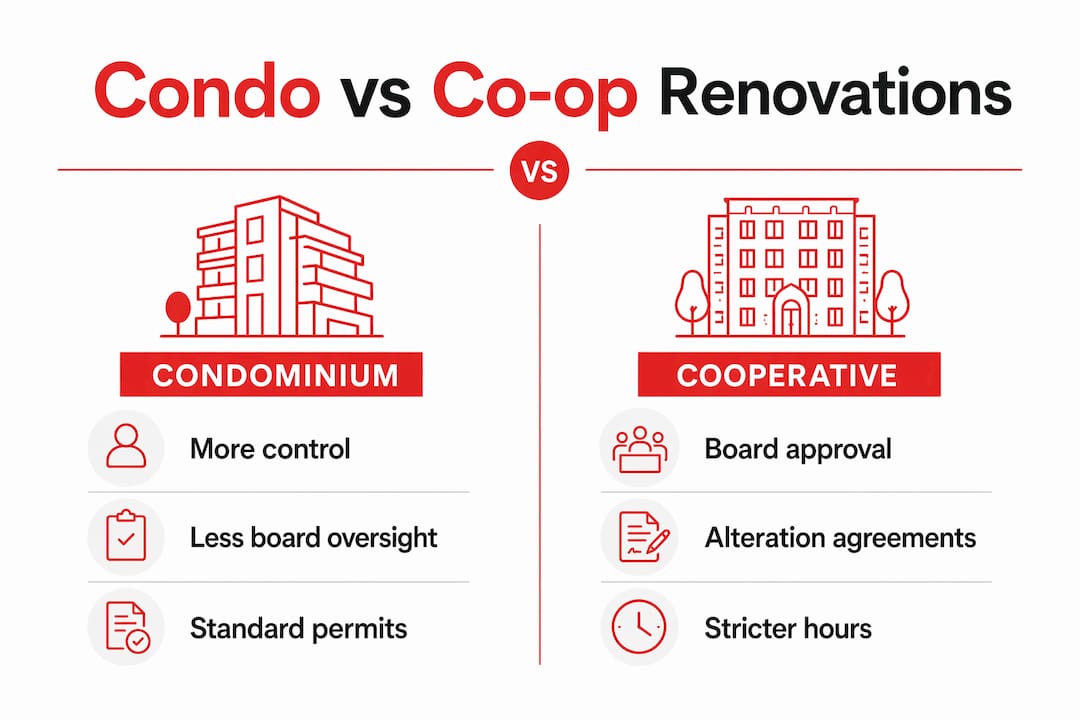
Condo renovation gives you significantly more individual control than co-op renovation, which requires board-controlled alteration agreements for nearly every permitted modification. Understanding how condo renovation differs from co-op renovation is the single most important thing you can do before buying in New York City. The two property types operate under fundamentally different legal frameworks, and those differences shape your timeline, your budget, and your freedom to design the home you actually want. The 2026 standardized alteration agreement, adopted by the New York State and City Bar Associations, applies exclusively to cooperative apartments. That one fact alone changes everything about how you plan a renovation.
How condo renovation differs from co-op renovation: the legal foundation
The core distinction comes down to governance documents. Co-ops operate under a proprietary lease and alteration agreements that give the board direct authority over renovation scope, insurance requirements, approved work hours, inspections, and fees. Condos operate under declarations and by-laws, which set renovation standards but grant boards far less authority over interior work.
Here is what that means in practice:
- Co-op alteration agreement: A binding contract between you and the co-op corporation. It defines exactly what work is permitted, what insurance you must carry, what hours contractors can work, and what deposits you must pay before a single tool is lifted.
- Condo declaration and by-laws: Governing documents that outline renovation standards and require permit compliance, but do not require the same level of board pre-approval for interior modifications.
- Enforcement mechanisms: Condo boards pursue remedies through common charges and liens. Co-op boards have lease-based enforcement rights, including the ability to pursue additional rent claims or, in extreme cases, eviction.
- 2026 standardized alteration agreement: This new framework, developed to harmonize co-op renovation processes across New York, applies only to cooperative apartments. Applying it to a condo without major revisions would create serious legal conflicts with the condo’s declaration.
Pro Tip: Before you make an offer on any NYC property, request a copy of the alteration agreement or condo declaration. Read the renovation section before you fall in love with the apartment.
The 2026 update matters because it signals that co-op boards are becoming more organized and consistent in how they manage renovations. That is good news for transparency, but it also means more paperwork and more formal process on your end.

What does the approval process look like for each property type?
The approval process is where the day-to-day difference between co-op and condo renovations becomes most visible. Co-op renovation approvals are formal, multi-step, and board-dependent. Condo renovation approvals are faster and more focused on permit compliance.
For a co-op renovation, the typical sequence looks like this:
- Submit renovation plans to the managing agent, including contractor credentials, scope of work, and insurance certificates.
- Alteration agreement review by the board or its attorney, which may take several rounds of revision.
- Board vote or committee approval, scheduled around board meeting calendars.
- Permit filing with the NYC Department of Buildings (DOB), which applies to both co-ops and condos but must align with the board-approved scope.
- Pre-construction inspection of the unit, required by most co-op buildings before work begins.
Board approval for non-structural renovations typically takes 4–8 weeks. Structural changes or projects involving wet-over-dry configurations can extend that timeline to 12 weeks or longer. That is time you are paying carrying costs on a property you cannot yet improve.
Condo owners have the right to make interior alterations subject to declaration compliance. They must obtain permits and notify the board, but the process does not require the same formal board vote. That difference can save you 6–10 weeks on a project start date.
One area where both property types align: the NYC DOB permit process. Whether you own a co-op or a condo, any structural work, plumbing changes, or electrical upgrades require permits filed through the DOB. The difference is that in a co-op, the board must approve your scope before you can file. In a condo, you can often move to permitting faster. You can review the NYC permit types that apply to your project to understand which category your renovation falls into.
Co-op buildings also enforce stricter construction hours than the DOB’s standard noise code. Co-op construction hours typically run 9:00 AM to 5:00 PM on weekdays only. The DOB allows work from 7:00 AM to 6:00 PM. Some co-op buildings ban construction entirely during summer months or the December holiday period. Those restrictions directly extend your project timeline.
What does renovating a co-op actually cost compared to a condo?
The procedural differences between co-op and condo renovations translate directly into dollars. Co-op renovations typically cost 15–20% more than comparable condo renovations. That premium comes from several compounding factors.
- Board fees and legal review costs: Many co-ops charge application fees and require their attorney to review your alteration agreement. You pay that attorney’s bill.
- Refundable deposits: Co-ops routinely require a damage deposit, sometimes $5,000 to $15,000, held until post-construction inspection clears.
- Insurance requirements: Co-ops require your contractor to carry specific liability coverage and name the co-op corporation as an additional insured. Contractors who do not already carry that coverage may charge more.
- Extended timelines: Longer approval periods and restricted work hours mean your contractor spends more days on site. Day rates add up.
- Common pitfall: Buyers often budget for the renovation itself but forget the board-related costs entirely. A $60,000 kitchen renovation in a co-op can carry $8,000 to $12,000 in additional fees, deposits, and delays before a single cabinet is installed.
Condo owners bear renovation costs more directly. There are no corporate fees or damage deposits to the building, though your contractor still needs to comply with condo rules and carry appropriate insurance. The cost of NYC renovation overruns is real in both property types, but co-op buyers face a steeper baseline.
Pro Tip: When budgeting a co-op renovation, add 20% to your contractor estimate to cover board fees, deposits, insurance premiums, and the carrying costs of a longer approval timeline. Build that number into your purchase decision.
The logistical impact is just as significant as the financial one. Restricted work hours in a co-op mean a project that would take 8 weeks in a condo might take 12 weeks or more. If you are planning to move in by a specific date, that gap matters.
How does the wet-over-dry rule apply differently in co-ops and condos?
The wet-over-dry rule is one of the most misunderstood renovation restrictions in New York City, and it applies almost exclusively to co-ops. Understanding it before you buy can save you from a renovation plan that the board will never approve.
Wet-over-dry refers to placing a wet room (a bathroom, kitchen, or laundry area) directly above a dry room (a bedroom or living space) in the unit below. Pre-war Manhattan co-ops are particularly strict about this because older plumbing and subfloor construction creates real leak risk. A water leak from a bathroom into a neighbor’s bedroom is both a liability and a relationship problem.
Here is how the rule plays out in practice:
- Co-op prohibition: Most co-op alteration agreements explicitly ban wet-over-dry configurations. Moving a bathroom or kitchen to a location above a neighbor’s dry space requires a board waiver, enhanced waterproofing documentation, and sometimes written consent from the unit below.
- Waiver process: Some co-op boards will grant exceptions if you install a waterproofing membrane system and provide engineering documentation. That adds cost and approval time.
- Condo treatment: Condo renovations are subject to the NYC Plumbing Code, but condos do not impose the same private contractual prohibition. You can reconfigure wet rooms in a condo as long as your plans comply with code and receive DOB approval.
“The wet-over-dry rule stops more co-op renovation plans than any other single restriction. Buyers who fall in love with an open-plan kitchen concept often discover the board will never approve moving plumbing to that location.”
If you are buying a pre-war co-op apartment and planning significant layout changes, confirm the wet-over-dry restrictions in the alteration agreement before you close. A condo in the same building type gives you far more flexibility on plumbing reconfiguration.
Key takeaways
Co-op renovations require formal board approval through an alteration agreement, while condo renovations operate under declarations that give owners more autonomy and faster timelines.
| Point | Details |
|---|---|
| Legal framework | Co-ops use alteration agreements; condos use declarations with less board authority over interior work. |
| Approval timeline | Co-op approvals take 4–12 weeks; condo approvals are faster and less formal. |
| Cost premium | Co-op renovations cost 15–20% more due to board fees, deposits, and insurance requirements. |
| Wet-over-dry rule | Co-ops contractually prohibit wet-over-dry configurations; condos only require NYC Plumbing Code compliance. |
| 2026 update | The new standardized alteration agreement applies only to co-ops and cannot be used for condo renovations without major revisions. |
What we have learned working on both sides of this divide
After working on renovations across co-op and condo buildings throughout New York City, the pattern we see most often is this: buyers underestimate the co-op board’s role until they are already in contract. By then, the renovation plan they fell in love with is already colliding with an alteration agreement they have never read.
The 2026 standardized alteration agreement is a genuine improvement for co-op transparency. It creates a clearer framework for what boards can and cannot require. But it also formalizes a process that many buyers still treat as informal. If you are buying a co-op, treat the alteration agreement like a second set of building codes. It governs your renovation just as much as the NYC DOB does.
Condo buyers sometimes swing too far in the other direction. They assume that because board approval is lighter, anything goes. That is not true. Declaration compliance, permit requirements, and neighbor impact rules still apply. The difference is that you have more control over the process and a shorter path from idea to approved plans.
Our honest advice: engage the board or managing agent early, whether you are in a co-op or a condo. Ask specific questions about what your renovation requires before you finalize your design. And work with a contractor who has done this before in your specific building type. The co-op renovation process is genuinely different from the condo renovation process, and experience with one does not automatically transfer to the other.
— D&J
How Designsbydandj helps you renovate with confidence
Navigating co-op board approvals and condo declaration requirements is exactly the kind of complexity that slows buyers down. Designsbydandj works with homeowners across New York City on both co-op and condo renovations, managing the approval process, permit filings, and contractor coordination from start to finish.

We know what co-op boards look for in an alteration agreement submission, and we know how to move a condo renovation from approved plans to completed project without surprises. If you are planning a renovation and want a clear picture of scope, budget, and timeline before you commit, start with our free homeowner checklist. When you are ready to talk through your project, our guide on hiring a design-build contractor walks you through exactly what to look for. Reach out to Designsbydandj early. The earlier we get involved, the smoother your renovation goes.
FAQ
What is the main difference between co-op and condo renovations?
Co-op renovations require a board-approved alteration agreement before any permitted work begins, while condo renovations are governed by declarations and by-laws that give owners more autonomy and require less formal board pre-approval.
How long does co-op renovation approval take?
Non-structural co-op renovations typically take 4–8 weeks for board approval. Structural changes or wet-over-dry modifications can extend that timeline to 12 weeks or more depending on board meeting schedules.
Does the 2026 standardized alteration agreement apply to condos?
No. The 2026 standardized alteration agreement applies exclusively to cooperative apartments. Applying it to a condo without significant revisions would conflict with the condo’s declaration and governance structure.
What is the wet-over-dry rule and does it apply to condos?
The wet-over-dry rule prohibits placing a bathroom or kitchen above a dry living space in the unit below. It is a private contractual restriction common in co-op alteration agreements, particularly in pre-war buildings. Condos do not impose this restriction contractually, though NYC Plumbing Code still applies.
Why do co-op renovations cost more than condo renovations?
Co-op renovations cost 15–20% more on average due to board fees, required damage deposits, contractor insurance mandates, and longer approval timelines that extend overall project duration.
Recommended
- NYC Co-op & Condo Board Renovation Guide | Designs by D and J – Designs by D and J
- How to Renovate a NYC Co-op: A Step-by-Step Guide – Designs by D and J
- The NYC Co-op Renovation Checklist: Everything You Need Before You Start – Designs by D and J
- co-op Pre war Apartment renovation – Designs by D and J